
Chemistry class throws a problem at you — “How many moles are in 36 grams of water?” — and suddenly you are staring at two units that seem to have nothing to do with each other.
Grams make sense. You weigh things in grams. But moles? That sounds like something chemists invented just to make life harder.
Here is the truth: the mole is actually one of the most useful ideas in all of chemistry — and converting grams to moles comes down to a single formula that takes about 30 seconds once you know it. This guide walks you through exactly that, with real examples ranging from water and salt to KMnO₄ and Na₂O, the common mistakes that cost students marks in NEET and JEE, and a full practice set with answers.
Table of Contents
What Is a Mole — And Why Does It Exist?
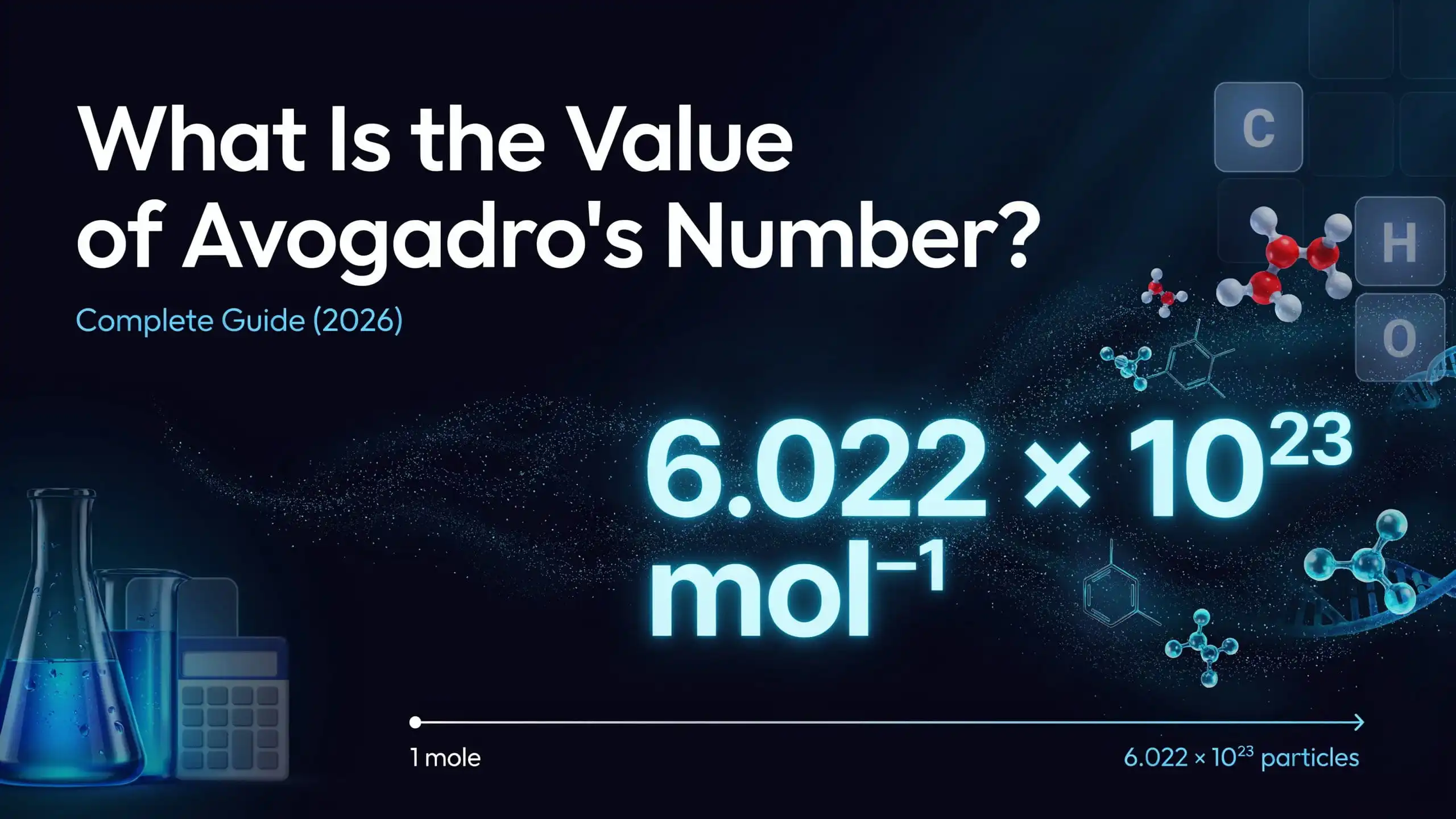
A mole is a counting unit — just like a "dozen" means 12, one mole means exactly 6.022 × 10²³ particles (atoms, molecules, or ions).
The reason chemists use moles instead of directly counting atoms is scale. A single water molecule weighs approximately 0.000000000000000000000003 grams. Working with numbers like that in every equation would make chemistry completely impractical.
The mole solves this by giving chemists a bridge between the invisible world of atoms and the measurable world of grams on a lab scale. One mole of any substance contains the same number of particles — 6.022 × 10²³ — regardless of what that substance is. This makes comparisons between different chemicals consistent and meaningful.
For the full story behind why Avogadro's Number is 6.022 × 10²³ and not some other value, see our detailed guide on the history and significance of this fundamental constant.
The Grams to Moles Formula
There is only one formula you need:
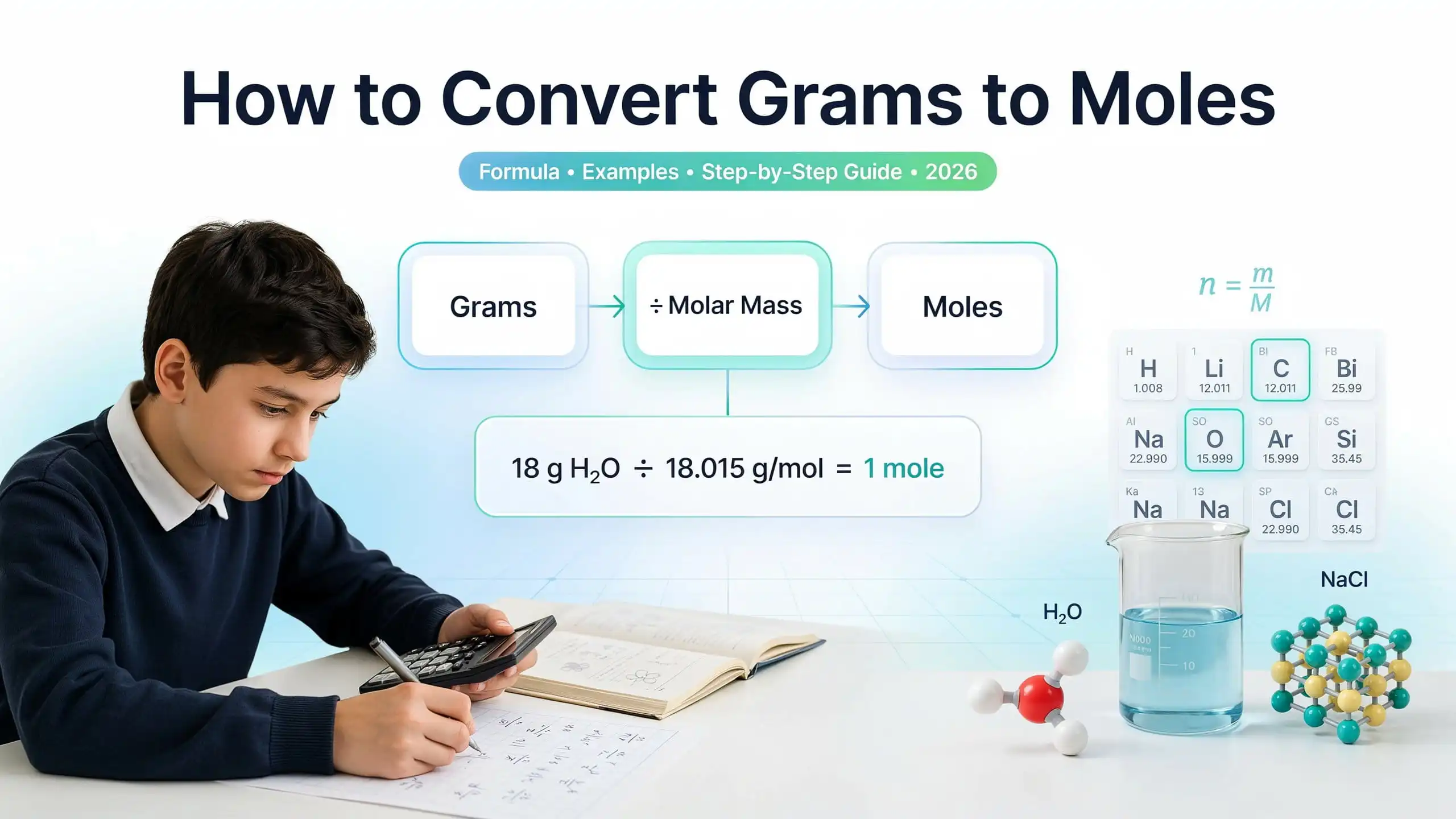
Moles = Grams ÷ Molar Mass
In symbols:
n = m ÷ M
Where:
- n = amount in moles (what you want to find)
- m = mass in grams (given in the problem)
- M = molar mass in g/mol (calculated from the periodic table)
The reverse — when moles are given and grams are needed — is just the same formula rearranged:
Grams = Moles × Molar Mass
Think of these three quantities as a triangle. Cover the one you want to find, and the remaining two show you the operation — divide m by M to get moles, or multiply n by M to get grams. You can also verify any result instantly using our free Moles to Grams Solver before submitting homework or exam answers.
What Is Molar Mass and How Do You Find It?
Molar mass is the mass of exactly one mole of a substance, expressed in grams per mole (g/mol). For elements, the molar mass is the atomic mass shown on the periodic table, with the unit changed from amu to g/mol.
For compounds, you add up the molar masses of every atom in the formula, multiplying each by the number of times that atom appears — the subscript.
Worked Examples of Molar Mass Calculation
Water — H₂O:
- H: 2 × 1.008 = 2.016
- O: 1 × 15.999 = 15.999
- Molar mass = 18.015 g/mol
Sodium Chloride — NaCl:
- Na: 1 × 22.990 = 22.990
- Cl: 1 × 35.453 = 35.453
- Molar mass = 58.443 g/mol
Sodium Oxide — Na₂O:
- Na: 2 × 22.990 = 45.980
- O: 1 × 15.999 = 15.999
- Molar mass = 61.979 g/mol
Sulfuric Acid — H₂SO₄:
- H: 2 × 1.008 = 2.016
- S: 1 × 32.065 = 32.065
- O: 4 × 15.999 = 63.996
- Molar mass = 98.077 g/mol
For a complete reference with over 50 compounds already calculated, check the molar mass reference table for common compounds.
Step-by-Step Method: Grams to Moles
Step 1 — Identify the mass in grams
Read the problem carefully and note the mass given. If the value is in milligrams, divide by 1000 first. If it is in kilograms, multiply by 1000. The formula only works when mass is in grams.
Step 2 — Calculate the molar mass of the compound
Write out the chemical formula. Find each element's atomic mass from the periodic table. Multiply each by its subscript and add them all together. This is where most errors happen — take your time here.
Step 3 — Divide mass by molar mass
Apply the formula: Moles = Grams ÷ Molar Mass. Check that units cancel correctly — grams in the numerator and grams per mole in the denominator leave you with moles.
Step 4 — Apply significant figures
Your answer should carry the same number of significant figures as the least precise value in the problem. If the problem gives 25.0 grams (3 sig figs), your answer should also have 3 significant figures.
Step 5 — Verify your answer
If the result seems unreasonably large or small, go back and recheck your molar mass calculation first. A single missed subscript is almost always the cause.
Solved Examples — Simple to Advanced
Example 1 — Water (H₂O)
Problem: How many moles are in 36 grams of water?
- Molar mass of H₂O = 18.015 g/mol
- Moles = 36 ÷ 18.015 = 2.0 mol
36 grams of water fits in a small glass. That glass contains 2 full moles — roughly 1.2 × 10²⁴ molecules. The scale chemistry operates on is genuinely staggering.
Example 2 — Table Salt (NaCl)
Problem: How many moles are in 58.5 grams of sodium chloride?
- Molar mass of NaCl = 58.443 g/mol
- Moles = 58.5 ÷ 58.443 = 1.001 mol ≈ 1.0 mol
A useful reference to memorise: approximately 58.5 grams of NaCl equals almost exactly 1 mole.
Example 3 — Carbon Dioxide (CO₂)
Problem: How many moles are in 44 grams of CO₂?
- C: 12.011 | O: 2 × 15.999 = 31.998
- Molar mass of CO₂ = 44.009 g/mol
- Moles = 44 ÷ 44.009 = 0.9998 mol ≈ 1.0 mol
Another anchor worth memorising: 44 grams of CO₂ ≈ 1 mole.
Example 4 — Sodium Oxide (Na₂O) — Reverse Conversion
Problem: How many grams are in 3.7 moles of Na₂O?
This is the reverse conversion — moles are given, grams are needed.
- Na: 2 × 22.990 = 45.980
- O: 1 × 15.999 = 15.999
- Molar mass of Na₂O = 61.979 g/mol
- Grams = 3.7 × 61.979 = 229.3 grams
This specific problem — including its full stoichiometric context and unit analysis — is covered step by step in our article on working through the 3.7 moles of Na₂O problem.
Example 5 — Potassium Permanganate (KMnO₄) — NEET/JEE Level
Problem: How many moles are in 25.0 grams of KMnO₄?
- K: 1 × 39.098 = 39.098
- Mn: 1 × 54.938 = 54.938
- O: 4 × 15.999 = 63.996
- Molar mass = 158.032 g/mol
- Moles = 25.0 ÷ 158.032 = 0.158 mol
KMnO₄ is a favourite in both NEET practicals and JEE problems because its large molar mass rewards careful, systematic calculation over guesswork.
Example 6 — Glucose (C₆H₁₂O₆) — Biology Meets Chemistry
Problem: How many moles are in 90 grams of glucose?
- C: 6 × 12.011 = 72.066
- H: 12 × 1.008 = 12.096
- O: 6 × 15.999 = 95.994
- Molar mass = 180.156 g/mol
- Moles = 90 ÷ 180.156 = 0.4996 mol ≈ 0.5 mol
The human body regulates blood glucose in millimoles per litre (mmol/L) — a direct clinical application of this exact conversion.
Quick Reference Conversion Table
| Compound | Formula | Molar Mass (g/mol) | Moles in 100g |
| Water | H₂O | 18.015 | 5.55 mol |
| Carbon Dioxide | CO₂ | 44.009 | 2.27 mol |
| Oxygen Gas | O₂ | 31.998 | 3.13 mol |
| Sodium Chloride | NaCl | 58.443 | 1.71 mol |
| Sodium Hydroxide | NaOH | 39.997 | 2.50 mol |
| Ammonia | NH₃ | 17.031 | 5.87 mol |
| Sulfuric Acid | H₂SO₄ | 98.077 | 1.02 mol |
| Hydrochloric Acid | HCl | 36.461 | 2.74 mol |
| Calcium Carbonate | CaCO₃ | 100.086 | 0.999 mol |
| Glucose | C₆H₁₂O₆ | 180.156 | 0.555 mol |
| Sodium Oxide | Na₂O | 61.979 | 1.61 mol |
| Potassium Permanganate | KMnO₄ | 158.032 | 0.633 mol |
| Ethanol | C₂H₅OH | 46.068 | 2.17 mol |
| Urea | CH₄N₂O | 60.056 | 1.66 mol |
Connecting Moles to Avogadro's Number
Once you have moles, you can find the actual number of particles using:
Number of particles = Moles × 6.022 × 10²³
Example: 2.0 moles of H₂O contains:
2.0 × 6.022 × 10²³ = 1.204 × 10²⁴ molecules
The reverse:
Moles = Number of particles ÷ 6.022 × 10²³
This three-way relationship — grams, moles, and particles — is the backbone of the entire mole concept in chemistry. Understanding how molar mass fits into this chain is what separates students who find stoichiometry intuitive from those who find it confusing. For a deeper look at the calculation methods, our guide on how to calculate molar mass from first principles covers every compound type including hydrates and polyatomic ions.
Common Mistakes Students Make
Mistake 1 — Forgetting subscripts in molar mass
The most frequent error. H₂O has two hydrogen atoms, not one. Na₂O has two sodium atoms. Always count every subscript before adding atomic masses — one missed subscript throws the entire answer off.
Mistake 2 — Using the wrong mass units
The formula only works with grams. If a problem gives 500 mg, convert first: 500 ÷ 1000 = 0.5 g. If given in kg, multiply by 1000. Chemistry is unforgiving about units.
Mistake 3 — Dividing instead of multiplying (or vice versa)
Grams → Moles: divide by molar mass. Moles → Grams: multiply by molar mass. The triangle method makes this clear — cover what you want to find, and the remaining two values show the operation.
Mistake 4 — Ignoring significant figures
NEET and JEE mark schemes pay close attention to this. If the given mass has 3 significant figures, your answer should too. 0.158 mol is correct; 0.15800 mol overstates your precision.
Mistake 5 — Confusing atomic mass with molar mass
Carbon's atomic mass is 12.011 amu — one atom. Carbon's molar mass is 12.011 g/mol — one mole of atoms. Numerically identical, but carry different units. Always use molar mass in calculations so units cancel correctly.
Real-World Applications
Medicine and Pharmacy: Drug dosages are calculated at the molecular level in moles, then converted to grams for prescriptions and IV bags. An error in this conversion has direct patient safety consequences — which is why pharmacists are trained extensively in mole calculations.
Industrial Chemistry: Fertiliser plants, pharmaceutical manufacturers, and petrochemical refineries run mole-based calculations continuously to control reaction yields, minimise raw material waste, and hit production targets.
Food Science: Professional food scientists work with exact molar ratios of ingredients to ensure chemical reactions — leavening, emulsification, caramelisation — happen reliably at scale.
Environmental Science: Air quality researchers convert pollutant concentrations from grams per cubic metre to moles per litre to understand the actual number of harmful molecules present in a given volume of air.
NEET and JEE Practice Problems
Work through these independently before checking the answers:
Q1. How many moles are in 49 grams of H₂SO₄?
Q2. What is the mass of 0.25 moles of CaCO₃?
Q3. How many moles are in 71 grams of Cl₂?
Q4. How many grams are in 3.7 moles of Na₂O?
Q5. Calculate the moles in 4.9 grams of NaOH.
Q6. How many molecules are in 18 grams of water?
Answers:
- H₂SO₄ = 98.077 g/mol → 49 ÷ 98.077 = 0.4996 ≈ 0.5 mol
- CaCO₃ = 100.086 g/mol → 0.25 × 100.086 = 25.02 g
- Cl₂ = 70.906 g/mol → 71 ÷ 70.906 = 1.001 ≈ 1.0 mol
- Na₂O = 61.979 g/mol → 3.7 × 61.979 = 229.3 g
- NaOH = 39.997 g/mol → 4.9 ÷ 39.997 = 0.1225 mol
- H₂O = 18.015 g/mol → 18 ÷ 18.015 = 0.9992 mol → 0.9992 × 6.022 × 10²³ = 6.02 × 10²³ molecules
Summary
| Conversion | Formula | Example |
| Grams → Moles | n = m ÷ M | 36 g H₂O ÷ 18.015 = 2.0 mol |
| Moles → Grams | m = n × M | 3.7 mol Na₂O × 61.979 = 229.3 g |
| Moles → Molecules | N = n × 6.022 × 10²³ | 2.0 × 6.022 × 10²³ = 1.2 × 10²⁴ |
| Molecules → Moles | n = N ÷ 6.022 × 10²³ | 1.2 × 10²⁴ ÷ 6.022 × 10²³ = 2.0 mol |
The core formula never changes: Moles = Grams ÷ Molar Mass. Master the molar mass calculation, respect subscripts and significant figures, and this conversion becomes second nature within a week of practice.
Frequently Asked Questions
What is the formula for converting grams to moles?
Moles = Grams ÷ Molar Mass (n = m ÷ M). The molar mass is calculated from the periodic table by adding the atomic masses of every atom in the compound's formula, each multiplied by its subscript.
What is the difference between molar mass and molecular mass?
Molecular mass is measured in atomic mass units (amu) and refers to a single molecule. Molar mass is measured in g/mol and refers to one mole of molecules. They are numerically equal but carry different units. In calculations, always use molar mass so that units cancel correctly.
What do I do if the mass is given in milligrams?
Divide by 1000 to convert to grams first. For example, 250 mg of NaCl = 0.25 g → 0.25 ÷ 58.443 = 0.00428 mol.
How many grams are in 3.7 moles of Na₂O?
Molar mass of Na₂O = 61.979 g/mol. Grams = 3.7 × 61.979 = 229.3 grams.
How do I convert moles to number of atoms or molecules?
Multiply moles by Avogadro's Number: Particles = moles × 6.022 × 10²³. For example, 0.5 moles of CO₂ contains 0.5 × 6.022 × 10²³ = 3.011 × 10²³ molecules.
How many moles are in 100 grams of water?
Molar mass of H₂O = 18.015 g/mol. Moles = 100 ÷ 18.015 = 5.55 mol.
Is molar mass the same for all physical states of a compound?
Yes. Molar mass depends only on the chemical formula, not the physical state. Liquid water and water vapour both have a molar mass of 18.015 g/mol.
Why does 1 mole of different substances have different masses?
Because different atoms have different masses. One mole always contains 6.022 × 10²³ particles — but heavier atoms naturally produce a heavier mole. Iron (55.845 g/mol) is much heavier per mole than hydrogen (1.008 g/mol) because each iron atom is far more massive.