
Every chemistry student memorises it: 6.022 × 10²³. It appears on formula sheets, in textbook margins, and in exam questions across NEET, JEE, A-Levels, and AP Chemistry worldwide.
But most students memorise the number without ever understanding what it actually means — or why it is that specific value and not something rounder like 10²⁴.
Use the calculator below to convert between moles and particles instantly, then read on for the full explanation.
Need to go from grams first? Use the Moles to Grams Solver to find moles, then convert to particles here.
This guide answers both questions properly. By the end, you will not just know Avogadro's Number — you will understand why it exists, where it came from, how it connects grams to atoms, and how to use it confidently in calculations.
Table of Contents
What Is Avogadro's Number?
Avogadro's Number is the number of particles — atoms, molecules, or ions — contained in exactly one mole of any substance.
Its value is:
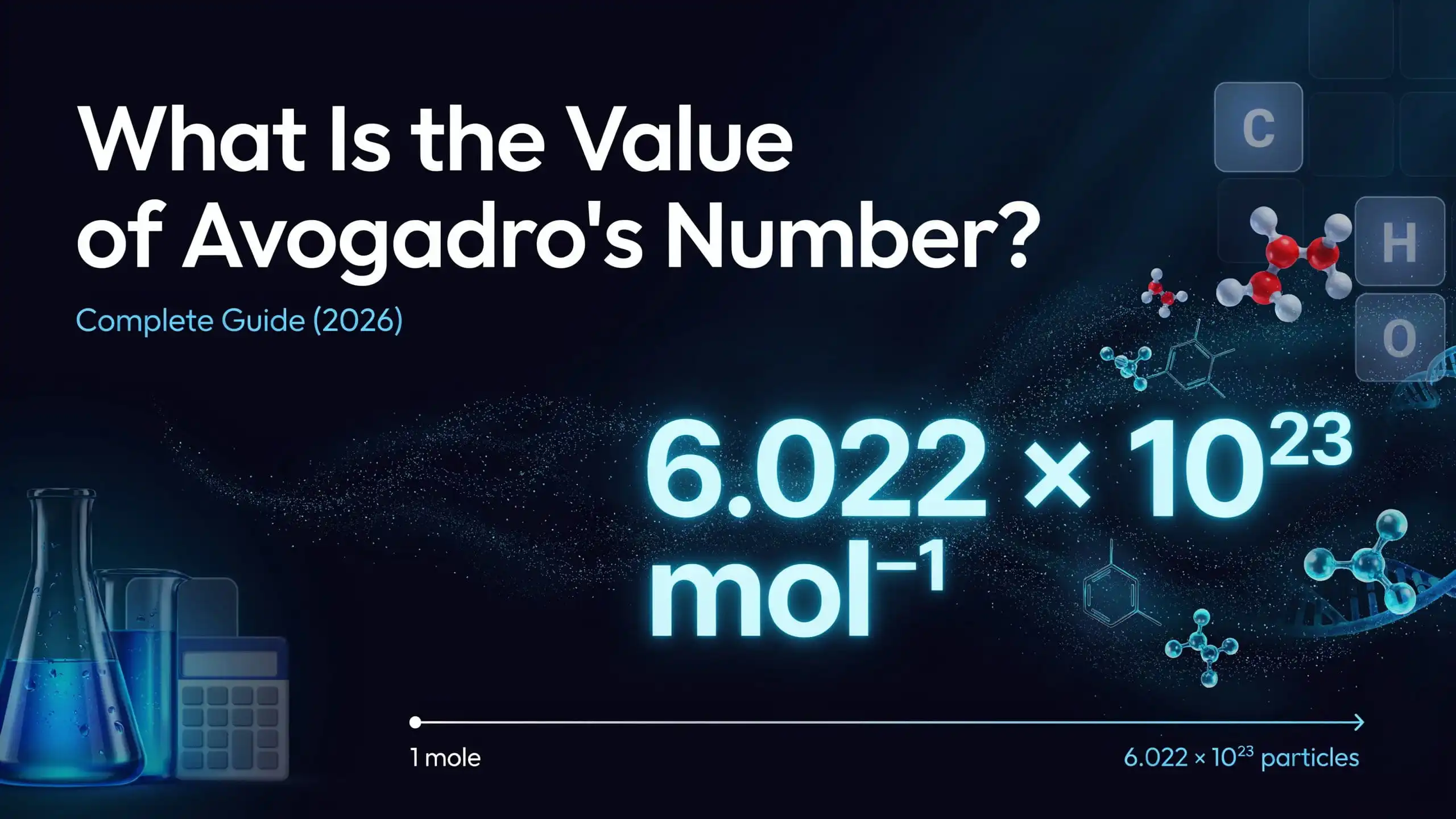
Nₐ = 6.02214076 × 10²³ mol⁻¹
In most textbooks and exams, this is rounded to:
Nₐ = 6.022 × 10²³ mol⁻¹
This number is a fundamental physical constant — like the speed of light or the charge of an electron. It does not change based on which substance you are working with. One mole of water, one mole of iron, and one mole of glucose all contain exactly 6.022 × 10²³ particles.
Why Is It Called Avogadro's Number?
The name honours Amedeo Avogadro (1776–1856), an Italian scientist who proposed in 1811 that equal volumes of gases at the same temperature and pressure contain equal numbers of molecules — regardless of what gas they are.
This idea, now called Avogadro's Law, was revolutionary at the time. It laid the groundwork for understanding that different substances could be compared by counting their particles rather than just weighing them.
However, Avogadro himself never calculated this number. He did not have the tools to do so. The actual determination of the constant came decades later through the work of scientists including Johann Josef Loschmidt (who first estimated it in 1865) and later Jean Baptiste Perrin, who experimentally confirmed it in the early 1900s and named it in Avogadro's honour.
Why This Specific Value — 6.022 × 10²³?
This is the question most textbooks never answer properly.
Avogadro's Number is not arbitrary. It is defined by a specific physical relationship:
One mole is defined as the number of atoms in exactly 12 grams of carbon-12.
Carbon-12 was chosen as the reference standard because it is stable, abundant, and its atomic mass is defined as exactly 12 atomic mass units (amu) by international agreement.
Here is how the number falls out:
- One carbon-12 atom has a mass of exactly 12 amu
- 1 amu = 1.66054 × 10⁻²⁴ grams
- Therefore, one carbon-12 atom weighs: 12 × 1.66054 × 10⁻²⁴ = 1.99265 × 10⁻²³ grams
- If 12 grams of carbon-12 is one mole, then the number of atoms in that mole is:
- 12 g ÷ 1.99265 × 10⁻²³ g/atom = 6.022 × 10²³ atoms
That is exactly where the number comes from. It is not chosen — it is derived from the relationship between the gram and the atomic mass unit.
In simple terms: Avogadro's Number is the number of atomic mass units that fit into one gram. Because 1 amu = 1.66054 × 10⁻²⁴ g, the number of amu per gram is 1 ÷ 1.66054 × 10⁻²⁴ = 6.022 × 10²³.
The 2019 Redefinition — What Changed?
Before 2019, the mole was defined as the number of atoms in 12 grams of carbon-12. Avogadro's Number was a measured quantity — something scientists determined experimentally and kept refining.
In May 2019, the International System of Units (SI) was revised. The mole is now defined by fixing Avogadro's Number exactly:
Nₐ = 6.02214076 × 10²³ mol⁻¹ (exact, by definition)
This means Avogadro's Number is no longer measured — it is defined. The relationship between the mole and carbon-12 is now a consequence of this definition rather than the other way around.
For NEET, JEE, A-Level, and AP Chemistry purposes, nothing changes in practice. You still use 6.022 × 10²³ in all calculations.
What Exactly Is a Mole?
The mole (symbol: mol) is the SI unit for amount of substance. It is one of the seven base SI units — alongside metre, kilogram, second, ampere, kelvin, and candela.
Think of it this way:
| Counting Unit | How Many? | Used For |
| Dozen | 12 | Eggs, donuts |
| Gross | 144 | Pencils, buttons |
| Ream | 500 | Sheets of paper |
| Mole | 6.022 × 10²³ | Atoms, molecules, ions |
A mole is simply a convenient number — chosen specifically so that the mass of one mole of any element in grams equals the atomic mass of that element in amu. This one-to-one correspondence is what makes the mole so powerful in chemistry calculations.
How Big Is 6.022 × 10²³ — Really?
Most students write this number without appreciating what it actually represents. Here are some comparisons that put it in perspective:
Grains of sand: There are estimated to be approximately 7.5 × 10¹⁸ grains of sand on all of Earth's beaches combined. One mole is roughly 80,000 times more than that.
Stars in the observable universe: Astronomers estimate around 10²⁴ stars in the observable universe — roughly the same order of magnitude as Avogadro's Number. One mole of atoms is comparable to the number of stars in the universe.
Seconds since the Big Bang: The universe is approximately 13.8 billion years old, which is about 4.35 × 10¹⁷ seconds. One mole is over a million times larger than this number.
Stacked paper: If you stacked 6.022 × 10²³ sheets of paper, the pile would extend approximately 6.5 × 10¹⁶ kilometres — well beyond the nearest star.
Atoms are so incredibly small that you need 6.022 × 10²³ of them just to make a chemically meaningful, weighable amount of a substance. This is the entire reason the mole — and Avogadro's Number — was invented.
Avogadro's Number in Calculations
Avogadro's Number acts as a conversion factor between the number of particles and the amount in moles.
Moles to Particles:
Particles = Moles × 6.022 × 10²³
Particles to Moles:
Moles = Particles ÷ 6.022 × 10²³
The Full Conversion Chain:
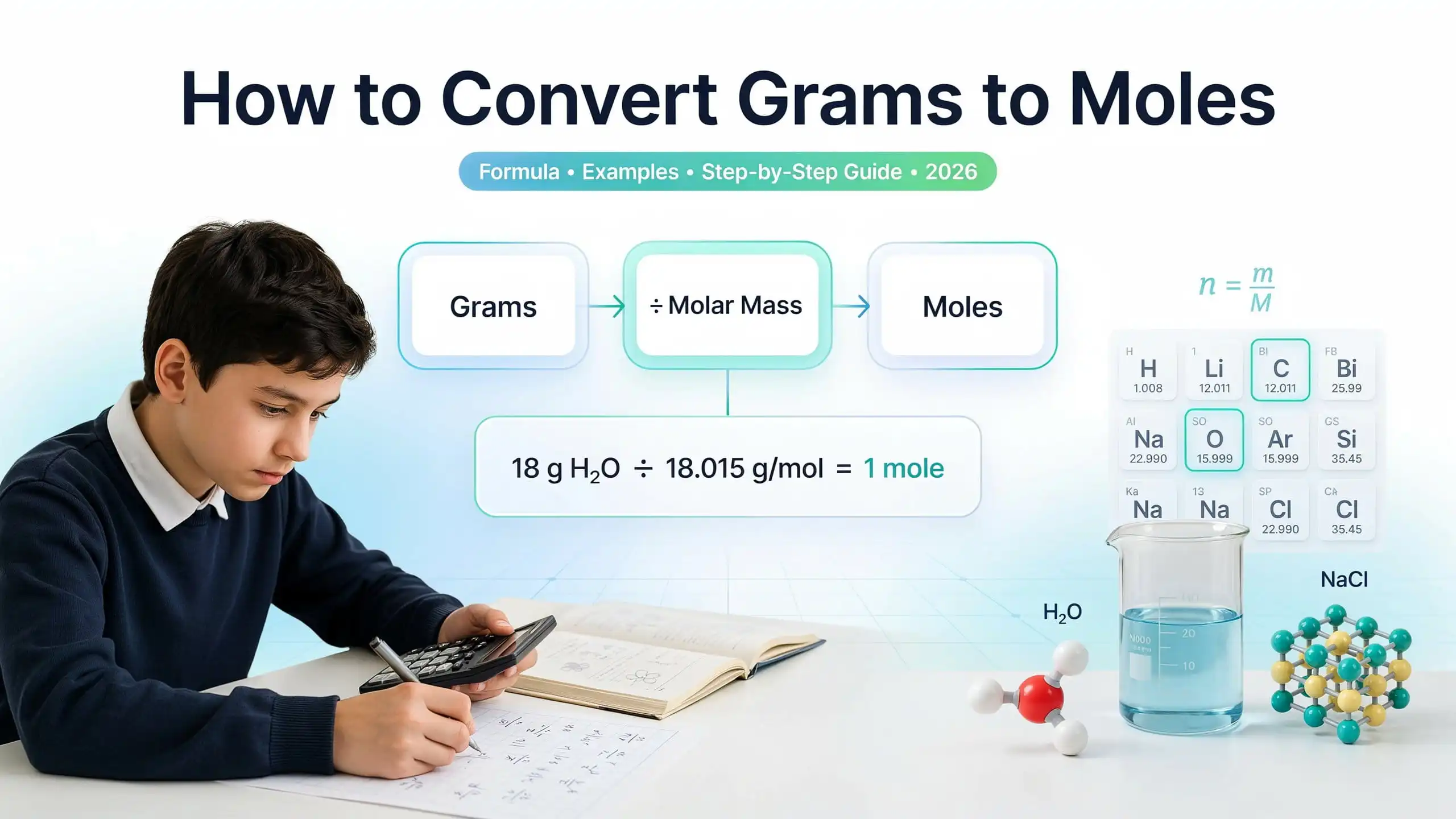
The most powerful application is combining Avogadro's Number with molar mass to move between grams, moles, and individual particles:
Grams ÷ Molar Mass → Moles × 6.022×10²³ → Particles
Grams ← Molar Mass × Moles ← 6.022×10²³ ÷ Particles
This three-way chain — grams, moles, particles — is the backbone of stoichiometry. Students who understand this chain find the rest of physical chemistry significantly more manageable. For a full walkthrough of the grams-to-moles step, our guide on converting grams to moles covers every compound type with six worked examples.
Solved Examples
Example 1 — Moles to Molecules (Water)
Problem: How many molecules are in 2.0 moles of water (H₂O)?
- Molecules = 2.0 × 6.022 × 10²³
- = 1.204 × 10²⁴ molecules
Two moles of water — about 36 grams, fitting in a small glass — contains over 1.2 quadrillion billion molecules.
Example 2 — Molecules to Moles (CO₂)
Problem: A sample contains 3.011 × 10²³ molecules of CO₂. How many moles is that?
- Moles = 3.011 × 10²³ ÷ 6.022 × 10²³
- = 0.5 mol
Example 3 — Grams to Molecules (NaCl)
Problem: How many formula units are in 58.44 grams of NaCl?
- Molar mass of NaCl = 58.443 g/mol
- Moles = 58.44 ÷ 58.443 = 1.0 mol
- Formula units = 1.0 × 6.022 × 10²³ = 6.022 × 10²³ formula units
Example 4 — Atoms in a Sample (Iron)
Problem: How many atoms are in 11.2 grams of iron (Fe)?
- Molar mass of Fe = 55.845 g/mol
- Moles = 11.2 ÷ 55.845 = 0.2006 mol
- Atoms = 0.2006 × 6.022 × 10²³ = 1.208 × 10²³ atoms
Example 5 — NEET Level (Molecules to Grams)
Problem: What is the mass of 1.2044 × 10²⁴ molecules of CO₂?
- Moles = 1.2044 × 10²⁴ ÷ 6.022 × 10²³ = 2.0 mol
- Molar mass of CO₂ = 44.009 g/mol
- Grams = 2.0 × 44.009 = 88.02 grams
Quick Reference Table — Moles, Particles, and Mass
| Substance | Moles | Particles | Mass |
| H₂O | 1.0 mol | 6.022 × 10²³ molecules | 18.015 g |
| NaCl | 1.0 mol | 6.022 × 10²³ formula units | 58.443 g |
| CO₂ | 1.0 mol | 6.022 × 10²³ molecules | 44.009 g |
| Fe | 1.0 mol | 6.022 × 10²³ atoms | 55.845 g |
| H₂O | 2.0 mol | 1.204 × 10²⁴ molecules | 36.03 g |
| CO₂ | 0.5 mol | 3.011 × 10²³ molecules | 22.005 g |
| Na₂O | 3.7 mol | 2.228 × 10²⁴ formula units | 229.3 g |
Loschmidt's Constant — The Related Number
You may encounter Loschmidt's Constant (Nₗ) in some texts — particularly in European chemistry and physics. This is the number of particles per unit volume of an ideal gas at standard temperature and pressure (STP):
Nₗ = 2.687 × 10²⁵ m⁻³
This is different from Avogadro's Number — Loschmidt's Constant refers to a volume-based count, while Avogadro's Number refers to a mole-based count. At STP, one mole of any ideal gas occupies 22.414 litres, so the two constants are related by:
Nₗ = Nₐ ÷ 22.414 L/mol × 1000 L/m³
For standard chemistry calculations — NEET, JEE, A-Level — you will always use Avogadro's Number, not Loschmidt's Constant.
Common Mistakes in Avogadro's Number Problems
Mistake 1 — Forgetting to convert grams to moles first
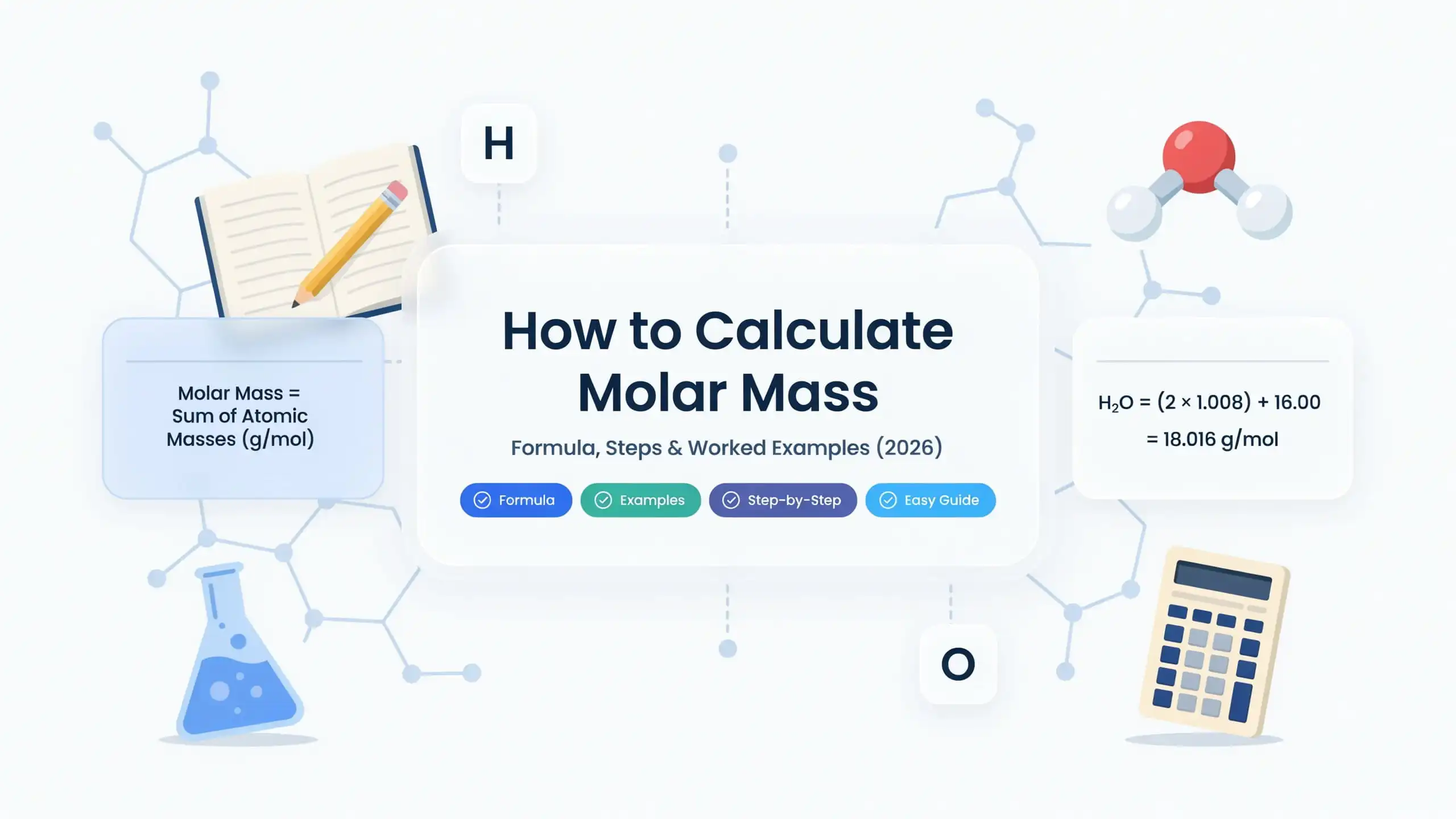
Avogadro's Number converts moles to particles — not grams to particles directly. Always calculate moles first using Moles = Grams ÷ Molar Mass, then multiply by 6.022 × 10²³. Knowing exactly how molar mass feeds into this step is covered in detail in our guide on how to calculate molar mass.
Mistake 2 — Confusing molecules and atoms
One molecule of H₂O contains 3 atoms (2 hydrogen + 1 oxygen). If a problem asks for atoms rather than molecules, multiply the number of molecules by the number of atoms per molecule.
Mistake 3 — Scientific notation errors
6.022 × 10²³ is easy to mistype as 6.022 × 10²² or 6.022 × 10²⁴. A factor-of-10 error gives a completely wrong answer. Double-check the exponent every time.
Mistake 4 — Using the wrong form of Avogadro's Number
Some problems give data in different units. Avogadro's Number is 6.022 × 10²³ per mole — the "per mole" part matters for unit cancellation. Write it as a fraction: 6.022 × 10²³ particles / 1 mol.
Mistake 5 — Mixing up formula units, molecules, and atoms
For ionic compounds like NaCl, the correct term is "formula units" — not molecules. NaCl does not exist as discrete molecules. For elements that exist as diatomic molecules (H₂, O₂, Cl₂), one mole contains 6.022 × 10²³ molecules but 2 × 6.022 × 10²³ atoms.
Real-World Significance of Avogadro's Number
Semiconductor manufacturing: Computer chips are built at the atomic scale. Engineers calculate exactly how many dopant atoms — often just parts per billion — must be introduced into silicon. Avogadro's Number underpins every such calculation.
Drug development: Pharmaceutical companies calculate drug concentrations in nanomoles per litre (nmol/L) — a unit that would make no sense without Avogadro's Number connecting particle counts to measurable masses.
Carbon dating: Radiocarbon dating uses the known decay rate of carbon-14 atoms. Calculating how many carbon-14 atoms are in a sample requires Avogadro's Number applied to the mass of carbon present.
Electrochemistry: Faraday's constant — the charge of one mole of electrons — is directly derived from Avogadro's Number multiplied by the charge of a single electron: F = Nₐ × e = 6.022 × 10²³ × 1.602 × 10⁻¹⁹ = 96,485 C/mol.
NEET and JEE Practice Problems
Q1. How many molecules are in 44 grams of CO₂?
Q2. A sample of nitrogen gas (N₂) contains 1.806 × 10²⁴ molecules. How many moles is this?
Q3. How many atoms are in 0.5 moles of Na₂O?
Q4. What is the mass of 3.011 × 10²³ molecules of glucose (C₆H₁₂O₆)?
Q5. How many electrons are present in 18 grams of water? (Each H₂O molecule has 10 electrons)
Answers:
- Moles of CO₂ = 44 ÷ 44.009 = 1.0 mol → 1.0 × 6.022 × 10²³ = 6.022 × 10²³ molecules
- Moles = 1.806 × 10²⁴ ÷ 6.022 × 10²³ = 3.0 mol
- Moles of Na₂O = 0.5 mol. Each formula unit has 3 atoms (2 Na + 1 O).
Atoms = 0.5 × 6.022 × 10²³ × 3 = 9.033 × 10²³ atoms - Moles = 3.011 × 10²³ ÷ 6.022 × 10²³ = 0.5 mol. Molar mass of glucose = 180.156 g/mol.
Mass = 0.5 × 180.156 = 90.08 grams - Moles of H₂O = 18 ÷ 18.015 = 1.0 mol → 6.022 × 10²³ molecules
Electrons = 6.022 × 10²³ × 10 = 6.022 × 10²⁴ electrons
Historical Timeline of Avogadro's Number
| Year | Scientist | Contribution |
|---|---|---|
| 1811 | Amedeo Avogadro | Proposed equal gas volumes contain equal particle counts |
| 1865 | Johann Josef Loschmidt | First estimated molecules per cm³ of gas |
| 1908 | Jean Baptiste Perrin | Experimentally confirmed via Brownian motion |
| 1909 | Jean Baptiste Perrin | Named the constant "Avogadro's Number" |
| 1926 | Jean Baptiste Perrin | Awarded Nobel Prize in Physics |
| 2019 | BIPM (International) | Avogadro's Number fixed as exact SI definition |
Frequently Asked Questions
What is the exact value of Avogadro's Number?
Since the 2019 SI redefinition, Avogadro's Number is exactly 6.02214076 × 10²³ mol⁻¹. For exam calculations, use the rounded value 6.022 × 10²³.
Why is Avogadro's Number not a round number?
Because it was not chosen — it was derived from physical reality. It is the number of atomic mass units that fit into one gram, which works out to 6.022 × 10²³. Nature does not adjust itself for human convenience.
What is the unit of Avogadro's Number?
mol⁻¹ (per mole). This unit is essential for correct dimensional analysis. When you multiply moles by Nₐ (mol⁻¹), the mol units cancel and you are left with the number of particles — a dimensionless count.
Is Avogadro's Number the same as the mole?
No. The mole is a unit of amount. Avogadro's Number is the count of particles in one mole. They are related but distinct — just as "dozen" is a unit and "12" is the count it represents.
How was Avogadro's Number first measured?
The first reasonably accurate estimate came from Johann Josef Loschmidt in 1865, who calculated the size of air molecules from viscosity data. Jean Perrin confirmed it experimentally in 1908 by observing Brownian motion under a microscope — work for which he received the Nobel Prize in Physics in 1926.
Does Avogadro's Number apply to ionic compounds?
Yes, but the term changes. For ionic compounds like NaCl, we say "formula units" rather than molecules, because ionic compounds exist as extended lattice structures rather than discrete molecules. One mole of NaCl contains 6.022 × 10²³ formula units.
What is the connection between Avogadro's Number and molar mass?
Molar mass (g/mol) tells you the mass of one mole of a substance. Avogadro's Number tells you how many particles are in that mole. Together they let you convert between grams, moles, and particle counts — the full conversion chain that underlies all of stoichiometry. For the molar mass side of this, our detailed article on finding the molar mass of any compound walks through every compound type including hydrates.
How does Avogadro's Number connect to molar mass?
Molar mass tells you the mass of one mole of a substance. Avogadro's Number tells you how many particles are in that mole. Together they let you convert between grams, moles, and particle counts. To see the complete mole-to-gram conversion worked out for specific compounds including Na₂O, see our solved example on how many grams are in 3.7 moles of Na₂O.
Summary
| Concept | Value / Formula |
| Avogadro's Number | 6.022 × 10²³ mol⁻¹ |
| Moles → Particles | Particles = mol × 6.022 × 10²³ |
| Particles → Moles | Moles = Particles ÷ 6.022 × 10²³ |
| Grams → Moles → Particles | n = m ÷ M, then N = n × 6.022 × 10²³ |
| Why this value? | Number of amu that fit in 1 gram |
| 2019 change | Now a fixed definition, not a measurement |
Avogadro's Number is not just a number to memorise — it is the bridge between the atomic world and the measurable world. Every stoichiometry calculation, every concentration problem, every electrochemistry equation ultimately traces back to this one constant.