

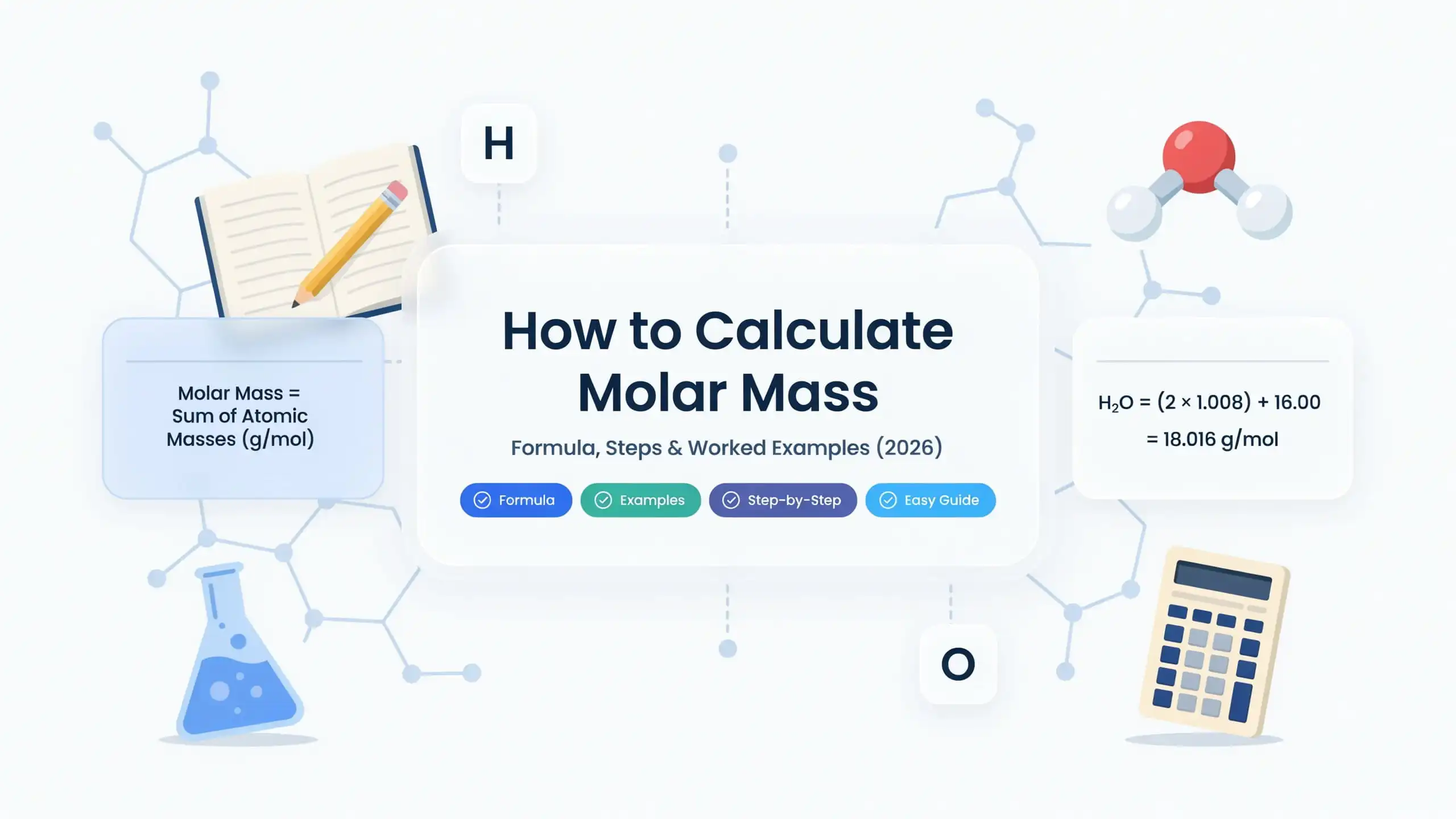
Every stoichiometry calculation in chemistry starts with the same input: molar mass. It is the number you need to convert grams to moles, prepare a solution of specific concentration, determine an empirical formula, or balance a chemical equation in mass terms.
Yet this is also where most calculation errors originate — not in the division or multiplication, but in reading the chemical formula incorrectly, missing a subscript, or mishandling parentheses.
Use the calculator below to build up any compound element by element, then read on for the complete method.
For hydrates, add H₂O as an element row (18.015 g/mol) with the count equal to the number of water molecules.
This guide covers the complete method: what molar mass is, how to calculate it for elements, simple compounds, complex compounds with nested parentheses, and hydrates — plus how to use it in the calculations that actually appear in coursework and exams.
Quick Answer:
Molar Mass = Sum of (Atomic Mass × Number of Atoms) for every element in the formula
Example: H₂O = (2 × 1.008) + (1 × 15.999) = 18.015 g/mol
Table of Contents
What Is Molar Mass?
Molar mass is the mass of exactly one mole of a substance, expressed in grams per mole (g/mol). It is calculated directly from the periodic table by adding the atomic masses of every atom in the compound's chemical formula.
Molar Mass (M) = Σ (Atomic Mass of Element × Number of Atoms of that Element)
The numerical value of molar mass in g/mol is always equal to the molecular mass in atomic mass units (amu) — only the units differ. This equivalence comes from the way the mole and the atomic mass unit were both defined relative to carbon-12, which is also the foundation of why Avogadro's Number takes the value it does. The full explanation of that connection is in our guide on what Avogadro's Number means and where it comes from.
Molar Mass vs Molecular Weight vs Formula Weight
These three terms are often used interchangeably in textbooks, but they are technically distinct:
| Term | Meaning | Units | Used For |
| Molar Mass | Mass of one mole of substance | g/mol | All practical calculations |
| Molecular Weight | Relative molecular mass (ratio to 1/12 of carbon-12 mass) | Dimensionless | Theoretical / comparative context |
| Formula Weight | Mass of one formula unit of an ionic compound | g/mol | Ionic compounds that don't form discrete molecules |
For all practical chemistry — stoichiometry, solution preparation, gas law problems — molar mass in g/mol is the term and unit you use. The distinction matters primarily in rigorous physical chemistry and metrology, not in standard coursework.
The Four-Step Method — Works for Every Compound
These four steps apply to every compound, regardless of complexity.
Step 1 — Write Out the Chemical Formula Clearly
If the formula has brackets, expand them first. If it is a hydrate, note the number of water molecules separately.
Step 2 — List Every Element and Count Its Atoms
Go through the formula systematically from left to right. Subscripts outside brackets multiply everything inside — this is where most errors happen.
Step 3 — Find the Atomic Mass of Each Element
Use the periodic table and keep at least three decimal places for accuracy. Standard atomic masses used throughout this guide:
| Element | Symbol | Atomic Mass (g/mol) |
| Hydrogen | H | 1.008 |
| Carbon | C | 12.011 |
| Nitrogen | N | 14.007 |
| Oxygen | O | 15.999 |
| Sodium | Na | 22.990 |
| Magnesium | Mg | 24.305 |
| Phosphorus | P | 30.974 |
| Sulfur | S | 32.065 |
| Chlorine | Cl | 35.453 |
| Potassium | K | 39.098 |
| Calcium | Ca | 40.078 |
| Iron | Fe | 55.845 |
| Copper | Cu | 63.546 |
| Zinc | Zn | 65.38 |
Step 4 — Multiply and Add
Multiply each element's atomic mass by its atom count, then add all results together. The total is the molar mass in g/mol.
Type 1 — Simple Elements
For single elements, the molar mass is simply the atomic mass from the periodic table, expressed in g/mol.
Example 1 — Iron (Fe)
Iron's atomic mass = 55.845 amu.
Molar mass of Fe = 55.845 g/mol
Example 2 — Diatomic Elements (The Common Trap)
Several elements exist naturally as diatomic molecules: H₂, N₂, O₂, F₂, Cl₂, Br₂, I₂.
When a problem refers to "oxygen gas" or "chlorine gas," it means O₂ and Cl₂ — not single atoms. The molar mass must reflect the diatomic formula.
Molar mass of O₂:
O: 2 × 15.999 = 31.998 g/mol
Molar mass of Cl₂:
Cl: 2 × 35.453 = 70.906 g/mol
Using 16 g/mol for oxygen gas instead of 32 g/mol halves your answer entirely. Always check whether the problem specifies an element in atomic or molecular form.
Type 2 — Simple Compounds (No Brackets)
For compounds without brackets, go element by element through the formula.
Example 3 — Water (H₂O)
| Element | Atoms | Atomic Mass | Contribution |
| H | 2 | 1.008 | 2.016 |
| O | 1 | 15.999 | 15.999 |
| Total | 18.015 g/mol |
Example 4 — Sulfuric Acid (H₂SO₄)
| Element | Atoms | Atomic Mass | Contribution |
| H | 2 | 1.008 | 2.016 |
| S | 1 | 32.065 | 32.065 |
| O | 4 | 15.999 | 63.996 |
| Total | 98.077 g/mol |
Example 5 — Sodium Oxide (Na₂O)
| Element | Atoms | Atomic Mass | Contribution |
| Na | 2 | 22.990 | 45.980 |
| O | 1 | 15.999 | 15.999 |
| Total | 61.979 g/mol |
Na₂O is one of the most frequently tested compounds in mole calculations. Once you have its molar mass, the next step is almost always a grams-moles conversion — worked through fully in our article on converting grams to moles.
Type 3 — Compounds With Brackets (Parentheses)
This is where most students make errors. When a formula has brackets with a subscript outside — like Ca(OH)₂ — that subscript multiplies every atom inside the bracket.
Rule: Subscript outside bracket × every atom inside bracket.
Example 6 — Calcium Hydroxide Ca(OH)₂
The subscript 2 means there are 2 OH groups. Expand first:
Ca(OH)₂ = Ca + 2O + 2H
| Element | Atoms | Atomic Mass | Contribution |
| Ca | 1 | 40.078 | 40.078 |
| O | 2 | 15.999 | 31.998 |
| H | 2 | 1.008 | 2.016 |
| Total | 74.092 g/mol |
Common mistake: Multiplying only H by 2 and forgetting O. Both atoms inside the bracket get multiplied.
Example 7 — Calcium Phosphate Ca₃(PO₄)₂
Expand the bracket: (PO₄)₂ = 2P + 8O
Ca₃(PO₄)₂ = 3Ca + 2P + 8O
| Element | Atoms | Atomic Mass | Contribution |
| Ca | 3 | 40.078 | 120.234 |
| P | 2 | 30.974 | 61.948 |
| O | 8 | 15.999 | 127.992 |
| Total | 310.174 g/mol |
Example 8 — Aluminium Sulfate Al₂(SO₄)₃
Expand: (SO₄)₃ = 3S + 12O
| Element | Atoms | Atomic Mass | Contribution |
| Al | 2 | 26.982 | 53.964 |
| S | 3 | 32.065 | 96.195 |
| O | 12 | 15.999 | 191.988 |
| Total | 342.147 g/mol |
Type 4 — Hydrates
Hydrates are ionic compounds that have water molecules incorporated into their crystal structure. The dot (·) in the formula means "combined with" — not multiplication.
M(hydrate) = M(anhydrous compound) + n × 18.015
Where n = number of water molecules per formula unit.
Example 9 — Copper Sulfate Pentahydrate CuSO₄·5H₂O
Step 1 — Anhydrous CuSO₄:
| Element | Atoms | Atomic Mass | Contribution |
| Cu | 1 | 63.546 | 63.546 |
| S | 1 | 32.065 | 32.065 |
| O | 4 | 15.999 | 63.996 |
| CuSO₄ Total | 159.607 g/mol |
Step 2 — Add water molecules:
5 × 18.015 = 90.075 g/mol
Step 3 — Final answer:
159.607 + 90.075 = 249.682 g/mol
Using the anhydrous molar mass (159.6) instead of the hydrate (249.7) means you are adding far less copper sulfate than intended — a critical error in lab work.
Example 10 — Washing Soda Na₂CO₃·10H₂O
Na₂CO₃: (2 × 22.990) + 12.011 + (3 × 15.999) = 105.988 g/mol
10 × H₂O: 10 × 18.015 = 180.150 g/mol
Total: 105.988 + 180.150 = 286.138 g/mol
Organic Compounds — Handling Large Molecules
Organic compounds follow the same four-step method. For large formulas, work through each element type systematically to avoid missing atoms.
Example 11 — Glucose C₆H₁₂O₆
| Element | Atoms | Atomic Mass | Contribution |
| C | 6 | 12.011 | 72.066 |
| H | 12 | 1.008 | 12.096 |
| O | 6 | 15.999 | 95.994 |
| Total | 180.156 g/mol |
Example 12 — Aspirin C₉H₈O₄
| Element | Atoms | Atomic Mass | Contribution |
| C | 9 | 12.011 | 108.099 |
| H | 8 | 1.008 | 8.064 |
| O | 4 | 15.999 | 63.996 |
| Total | 180.159 g/mol |
Notice that glucose and aspirin have almost identical molar masses despite being completely different compounds — a reminder that molar mass alone cannot identify a substance.
Molar Mass and Percent Composition
Once you have the molar mass, percent composition of each element follows directly:
% of element = (Atoms × Atomic Mass) ÷ Molar Mass × 100
Example — Percent Composition of H₂SO₄
Molar mass = 98.077 g/mol
- % H = (2 × 1.008) ÷ 98.077 × 100 = 2.06%
- % S = 32.065 ÷ 98.077 × 100 = 32.69%
- % O = (4 × 15.999) ÷ 98.077 × 100 = 65.25%
- Check: 2.06 + 32.69 + 65.25 = 100%
How Molar Mass Connects to the Rest of Chemistry
Grams to moles and back: Every conversion between grams and moles passes through molar mass. The formula Moles = Grams ÷ Molar Mass is the single most used equation in quantitative chemistry. To put your molar mass calculations directly to work, the Moles to Grams Solver handles any compound instantly — useful for checking homework before submission.
Stoichiometry: Balanced equations give mole ratios. Converting those ratios to gram quantities requires an accurate molar mass for every substance in the equation.
Molarity: Preparing a 1 mol/L NaOH solution means dissolving exactly 39.997 grams in enough water to make 1 litre. The gram quantity comes directly from molar mass.
Empirical and molecular formulas: Finding a molecular formula from empirical data means dividing the known molecular mass by the empirical formula mass — itself a molar mass calculation.
For pre-calculated values across 60+ compounds organised by category — acids, bases, salts, gases, organic, hydrates — the molar mass reference table saves time during revision and lab work.
Common Mistakes — And How to Avoid Them
Mistake 1 — Ignoring Subscripts Outside Brackets
In Ca(OH)₂, the 2 multiplies both O and H. Many students only multiply H. Always expand brackets completely before calculating.
Mistake 2 — Using Atomic Molar Mass for Diatomic Gases
Oxygen gas is O₂ = 31.998 g/mol, not O = 15.999 g/mol. The same applies to H₂, N₂, F₂, Cl₂, Br₂, and I₂.
Mistake 3 — Using Anhydrous Molar Mass for a Hydrate
CuSO₄·5H₂O = 249.7 g/mol, not 159.6 g/mol. Always check whether your compound has dot notation in its name or on the reagent bottle label.
Mistake 4 — Rounding Atomic Masses Too Early
Rounding hydrogen to 1 instead of 1.008 creates errors that compound in large organic molecules. Round only the final answer.
Mistake 5 — Confusing Molar Mass Units
Molar mass is in g/mol. Molecular mass is in amu. They are numerically equal but using amu in a moles calculation breaks unit cancellation. Always use g/mol.
Mistake 6 — Forgetting Isotopes in Specialised Problems
Standard molar mass uses natural isotope abundance averages — correct for most chemistry. In NMR spectroscopy or nuclear chemistry, specific isotopes like ¹³C or deuterium (²H) have different masses and must be calculated separately.
Quick Practice Problems
Q1. Calculate the molar mass of KNO₃.
Q2. Calculate the molar mass of Al₂O₃.
Q3. Calculate the molar mass of Mg(OH)₂.
Q4. Calculate the molar mass of Fe₂(SO₄)₃.
Q5. Calculate the molar mass of FeSO₄·7H₂O.
Q6. How many moles are in 49.05 grams of H₂SO₄?
Answers
- K: 39.098 + N: 14.007 + O: 3 × 15.999 = 101.102 g/mol
- Al: 2 × 26.982 + O: 3 × 15.999 = 101.961 g/mol
- Mg: 24.305 + O: 2 × 15.999 + H: 2 × 1.008 = 58.319 g/mol
- Fe: 2 × 55.845 + S: 3 × 32.065 + O: 12 × 15.999 = 399.873 g/mol
- FeSO₄: 151.906 g/mol + 7 × 18.015 = 278.011 g/mol
- Moles = 49.05 ÷ 98.077 = 0.5 mol
Summary — Molar Mass by Compound Type
| Compound Type | Example | Key Step | Molar Mass |
| Simple element | Fe | Atomic mass directly | 55.845 g/mol |
| Diatomic element | O₂ | 2 × atomic mass | 31.998 g/mol |
| Simple compound | H₂SO₄ | Add all atoms | 98.077 g/mol |
| Compound with brackets | Ca(OH)₂ | Expand brackets first | 74.092 g/mol |
| Complex bracket compound | Ca₃(PO₄)₂ | Expand all brackets | 310.174 g/mol |
| Hydrate | CuSO₄·5H₂O | Anhydrous + n × 18.015 | 249.682 g/mol |
| Organic molecule | Glucose C₆H₁₂O₆ | Count all atoms carefully | 180.156 g/mol |
Frequently Asked Questions
What is the formula for calculating molar mass?
Molar Mass = Σ (Atomic Mass × Number of Atoms). For each element in the formula, multiply its periodic table atomic mass by how many times it appears, then add all results.
How do I handle brackets in molar mass calculations?
The subscript outside the bracket multiplies every atom inside it. For Ca(OH)₂ — the 2 multiplies both O and H, giving 2 oxygens and 2 hydrogens. Expand brackets fully before counting atoms.
What is the molar mass of water?
H₂O: (2 × 1.008) + 15.999 = 18.015 g/mol. Approximated as 18 g/mol for quick calculations.
How do I calculate molar mass of a hydrate?
Add the molar mass of the anhydrous compound to n × 18.015, where n is the number of water molecules. For CuSO₄·5H₂O: 159.607 + (5 × 18.015) = 249.682 g/mol.
Can two different compounds have the same molar mass?
Yes — glucose and fructose are both C₆H₁₂O₆ at 180.156 g/mol. They are structural isomers. Molar mass alone cannot identify a compound.
How many significant figures should molar mass have?
Use three decimal places for atomic masses during calculation, rounding only the final answer. For NEET and JEE, three significant figures is standard.
What is the molar mass of Na₂O?
(2 × 22.990) + 15.999 = 61.979 g/mol. This value feeds directly into the Na₂O mole calculation covered in our article on 3.7 moles of Na₂O.
Is formula mass the same as molar mass?
For practical purposes, yes. For ionic compounds like NaCl, "formula mass" is technically more accurate since ionic compounds form lattice structures rather than discrete molecules. The calculation method is identical either way.