
Your marksheet shows two numbers — SGPA and CGPA. A job form asks for your percentage. A university application wants your cumulative score. And somewhere in the middle of all this, you are not entirely sure which number to use, which one actually matters, and whether they convert to percentage the same way.
This guide answers all of that — clearly, with real examples, and without padding it with things you do not need.
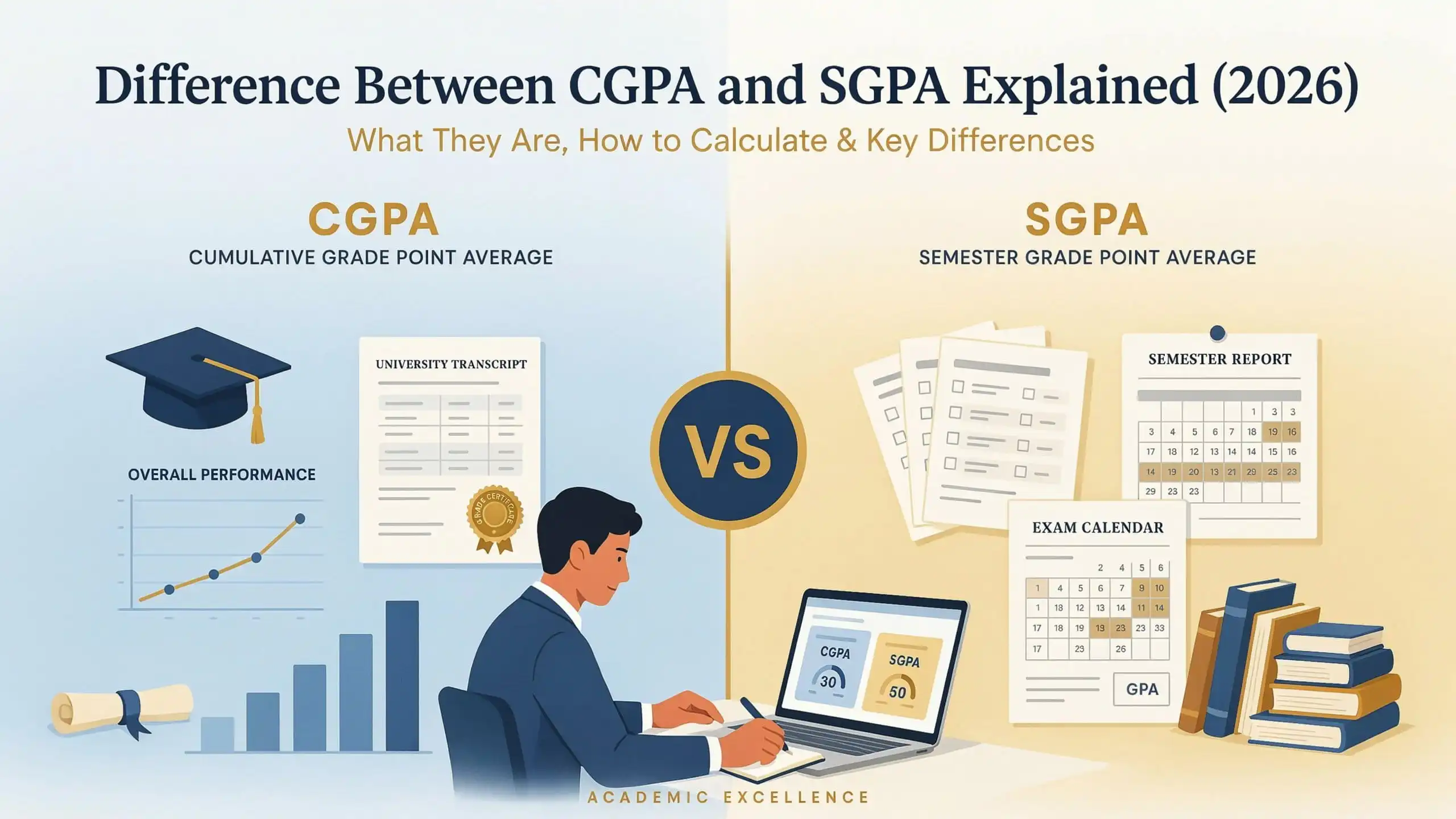
Short answer: SGPA is your score for one semester. CGPA is your score for your entire degree so far. For most formal applications — jobs, admissions, scholarships — CGPA is what matters.
Table of Contents
What Is SGPA?
SGPA stands for Semester Grade Point Average. It measures your academic performance in one specific semester — nothing before it, nothing after. When your semester ends, your university calculates your SGPA based on the grades you earned in each subject during those few months.
The formula is:
SGPA = Σ (Credit × Grade Point) ÷ Total Credits in that semester
Example — Semester 1:
| Subject | Credits | Grade | Grade Point | Credit × GP |
| Mathematics | 4 | A | 8 | 32 |
| Physics | 3 | B+ | 7 | 21 |
| Chemistry | 3 | A+ | 9 | 27 |
| English | 2 | A | 8 | 16 |
| Programming | 4 | O | 10 | 40 |
| Total | 16 | 136 |
SGPA = 136 ÷ 16 = 8.5
Once calculated, your SGPA for that semester is fixed. It does not change even if you perform better or worse later.
What Is CGPA?
CGPA stands for Cumulative Grade Point Average. It is the running average of your academic performance across every semester you have completed — not just the latest one.
Think of SGPA as a chapter result and CGPA as your overall score across the entire book.
Simple formula (equal credits across all semesters):
CGPA = Sum of all SGPAs ÷ Number of semesters completed
Example — 4 semesters completed:
| Semester | SGPA |
| Semester 1 | 8.5 |
| Semester 2 | 7.8 |
| Semester 3 | 8.2 |
| Semester 4 | 8.9 |
CGPA = (8.5 + 7.8 + 8.2 + 8.9) ÷ 4 = 33.4 ÷ 4 = 8.35
Important: The simple average above works only when every semester carries the same total credits. If Semester 3 had 20 credits and Semester 4 had 24, a credit-weighted formula is needed. Most universities handle this automatically and display the correct CGPA on your official transcript. Always use that official figure rather than calculating manually for formal applications.
CGPA vs SGPA: Key Differences at a Glance
| SGPA | CGPA | |
| Full form | Semester Grade Point Average | Cumulative Grade Point Average |
| What it covers | One semester only | All semesters completed |
| When it updates | End of each semester | End of each semester (cumulative) |
| Changes over time | Fixed after semester ends | Updates every semester |
| Used for | Semester reports, internal tracking | Job applications, admissions, scholarships |
| Affected by | That semester’s subjects only | Every semester since enrollment |
| Recovery possible? | No (fixed) | Yes — future semesters improve CGPA |
Which One Actually Matters More?
This is the real question most students have, and the honest answer is: it depends on what you are doing.
For Job Applications
Almost every employer — private sector, government, or MNC — looks at CGPA, not SGPA. Your CGPA appears on your degree certificate and final transcript. It is the number that represents your entire academic journey, which is why recruiters use it as a filter.
Specific examples in 2026:
- TCS, Infosys, Wipro, HCL — minimum 6.0 CGPA for campus placements
- Accenture, Deloitte, Capgemini — typically 6.5 CGPA cutoff
- McKinsey, BCG, Goldman Sachs — 7.5 to 8.0 CGPA from non-premier institutes
- Government jobs (SSC, UPSC, PSU) — percentage required, which is derived from CGPA
Your SGPA is rarely asked for at placement drives. What matters is the cumulative number across your degree.
For Postgraduate Admissions
Universities in India and abroad evaluate CGPA for admission eligibility. Some programs may ask for semester transcripts to check consistency — but the primary screen is still your overall CGPA.
For study abroad specifically:
- US MS programs — minimum CGPA 7.0 to 7.5 out of 10
- UK MSc — CGPA 6.5 and above for most Russell Group universities
- Germany — CGPA 7.4 and above for TU Munich and RWTH Aachen
For Scholarships
Both can matter here. Some scholarship boards check overall CGPA for eligibility while also reviewing SGPA trends to assess consistency. A student with a high CGPA but a sharp decline in recent SGPAs may raise flags. A student with an improving SGPA trajectory — even from a lower starting CGPA — can sometimes make a stronger case for need-based or merit-improvement awards.
For Your Own Tracking
SGPA is actually more useful for personal monitoring than CGPA is. If your Semester 3 SGPA drops from 8.2 to 6.8, that is a clear signal something went wrong — a difficult subject load, a personal issue, or a study approach that needs adjusting. CGPA, especially later in your degree, absorbs these dips and can mask them. Watching your SGPA each semester keeps you aware before problems compound.
How SGPA Affects Your CGPA Over Time
This is something most students underestimate — and it is worth understanding clearly.
CGPA becomes harder to move as you progress through your degree.
In your first semester, your SGPA is your CGPA. A single semester’s result has 100% weight. By your final semester of an eight-semester program, that semester’s SGPA has just 12.5% weight on your overall CGPA.
This works both ways:
Early poor performance is hard to recover from. A student who scores 5.5 SGPA in Semester 1 and 2, then consistently scores 8.5 from Semester 3 onwards, will finish with a CGPA of around 7.6 — not the 8.5 that their recent performance suggests.
Early strong performance provides a cushion. A student who scores 9.0 in Semesters 1 and 2, then faces a difficult patch with 6.5 in Semester 5, will still have a reasonable CGPA because the early work is already banked in.
Real example:
| Semester | SGPA | Cumulative CGPA After That Semester |
| 1 | 5.5 | 5.50 |
| 2 | 5.5 | 5.50 |
| 3 | 8.5 | 6.50 |
| 4 | 8.5 | 7.00 |
| 5 | 8.5 | 7.30 |
| 6 | 8.5 | 7.50 |
| 7 | 8.5 | 7.64 |
| 8 | 8.5 | 7.75 |
Despite performing excellently from Semester 3 onwards, this student graduates with 7.75 CGPA — not 8.5. The early semesters never fully go away.
This is why first and second year performance matters far more than students typically realize when they are living through it.
How to Convert SGPA to Percentage
Yes, you can convert SGPA to percentage using the same formula as CGPA. Use this only when a form specifically asks for a semester percentage — which is uncommon. For most applications, convert your CGPA, not SGPA.
Standard formula (CBSE and most UGC universities):
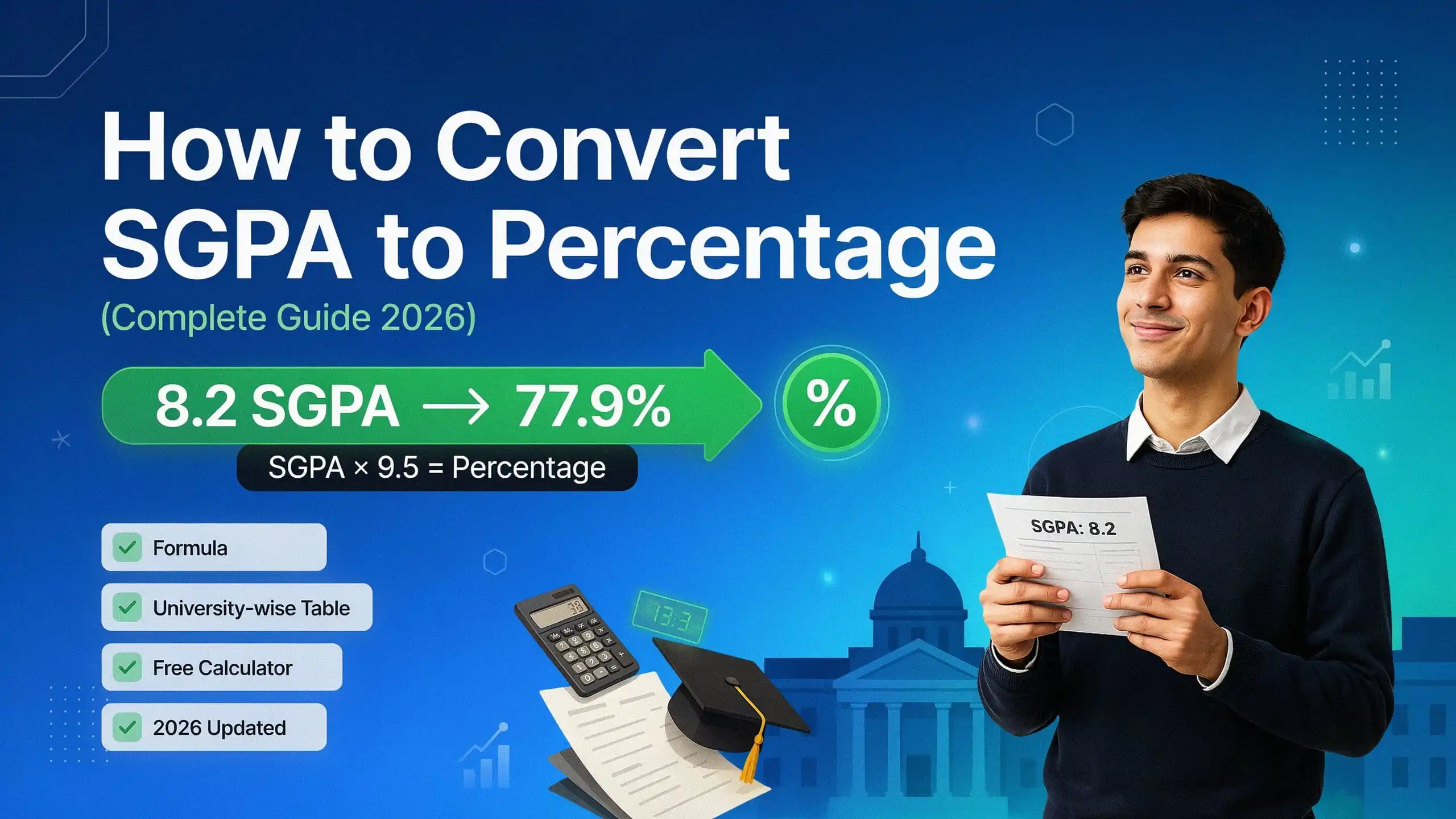
Percentage = SGPA × 9.5
For VTU, Anna University, JNTU, KTU:
Percentage = SGPA × 10
Example: SGPA of 8.5 at a CBSE-affiliated university → 8.5 × 9.5 = 80.75%
For the complete list of university-specific conversion formulas, see our full guide: How to Convert CGPA to Percentage.
How to Calculate CGPA from SGPA
Once you have your semester-wise SGPAs, calculating CGPA is straightforward.
When all semesters have equal total credits:
CGPA = (SGPA₁ + SGPA₂ + … + SGPAₙ) ÷ n
When semesters have different total credits (credit-weighted method):
CGPA = Σ (SGPA × Total Credits That Semester) ÷ Σ Total Credits Across All Semesters
Credit-weighted example:
| Semester | SGPA | Total Credits | SGPA × Credits |
| 1 | 8.2 | 20 | 164 |
| 2 | 7.8 | 22 | 171.6 |
| 3 | 8.5 | 24 | 204 |
| 4 | 8.0 | 22 | 176 |
| Total | 88 | 715.6 |
CGPA = 715.6 ÷ 88 = 8.13
Compare this to the simple average: (8.2 + 7.8 + 8.5 + 8.0) ÷ 4 = 8.125. In this case they are close, but when credit totals vary significantly across semesters, the difference becomes meaningful.
Always use the official CGPA from your transcript for formal applications.
A Scenario That Shows Why This Distinction Matters
Neha completed her B.Tech with a CGPA of 7.2. During campus placements, TCS asked for her percentage. She opened our Grade Converter, entered 7.2, and got 68.4% using her university’s formula (× 9.5). She entered that on the form and cleared the 60% filter.
Her friend Karan, from the same batch, made a different mistake. The placement portal asked for his cumulative academic performance. Karan entered his most recent SGPA of 8.6 from Semester 8 — thinking it would look better than his CGPA of 7.0. The portal was looking for CGPA. His entered value of 8.6 looked like a CGPA, passed the filter, but created a mismatch when the recruiter cross-checked his transcript showing 7.0 overall. He was asked to explain the discrepancy in his interview.
Always enter what the form is actually asking for. CGPA and SGPA are not interchangeable.
CGPA vs SGPA: Quick Reference
| Situation | Use CGPA or SGPA? |
| Job application form | CGPA |
| Government exam eligibility | CGPA (converted to %) |
| University admission (India) | CGPA |
| Study abroad application | CGPA |
| Scholarship form | CGPA (sometimes both) |
| Internship application | Check form — usually CGPA |
| Personal semester tracking | SGPA |
| Understanding one bad semester | SGPA |
Final Thought
SGPA tells you how a single chapter went. CGPA tells the story of your entire degree. Both numbers appear on your transcript, but they serve different purposes — and using the wrong one on a formal application creates problems that are entirely avoidable.
If you need to convert your CGPA or SGPA to percentage, use the free Grade Converter at AIHomeworkHelps to get the right figure for your university’s formula before submitting any application.
For the full conversion guide including university-specific formulas for CBSE, AKTU, VTU, Anna University, and more, see: How to Convert CGPA to Percentage .
Common Questions
Can SGPA be higher than CGPA?
Yes, easily. If you performed better in recent semesters than your earlier ones, your latest SGPA will be above your CGPA. This is common for students who struggled initially and improved over time.
Can SGPA be lower than CGPA?
Yes. A difficult semester, a tough subject load, or a personal setback can pull your SGPA below your cumulative average. Your CGPA absorbs the hit but does not drop as sharply.
Does a low SGPA ruin your CGPA permanently?
Not permanently — but recovery is harder the later it happens. One poor semester early in your degree has more long-term damage than one poor semester in your final year, simply because there are fewer future semesters to compensate.
Which should I mention on my resume?
Always CGPA. If your CGPA is below what a job requires but your recent SGPAs are strong, you can mention the trend in your cover letter or interview — but the primary figure on the resume should be CGPA.
Do companies ever ask for SGPA?
Occasionally, for specific purposes. Some internship applications ask for your most recent semester’s SGPA to gauge current performance. A few companies in research and analytics check semester-wise transcripts during background verification. But for standard placements, CGPA is the metric.
Is SGPA the same as GPA?
SGPA is equivalent to a semester GPA. In the US system, GPA is often reported cumulatively (similar to CGPA in India). The difference is mainly in terminology — the underlying concept of grade-point averaging is the same.