
You have your marks in front of you. The form is asking for a percentage. And you are wondering whether it is just a simple division, or whether there is something you might be getting wrong.
For most cases, the calculation is straightforward. But there are a few situations — multiple subjects with different totals, boards with internal assessments, or forms asking for aggregate vs subject-wise percentage — where students make avoidable errors that affect their eligibility.
This guide covers all of it: the core formula, step-by-step examples, multi-subject calculations, board-specific methods, reverse calculation, and real scenarios where getting this wrong has actual consequences.
Quick Answer:
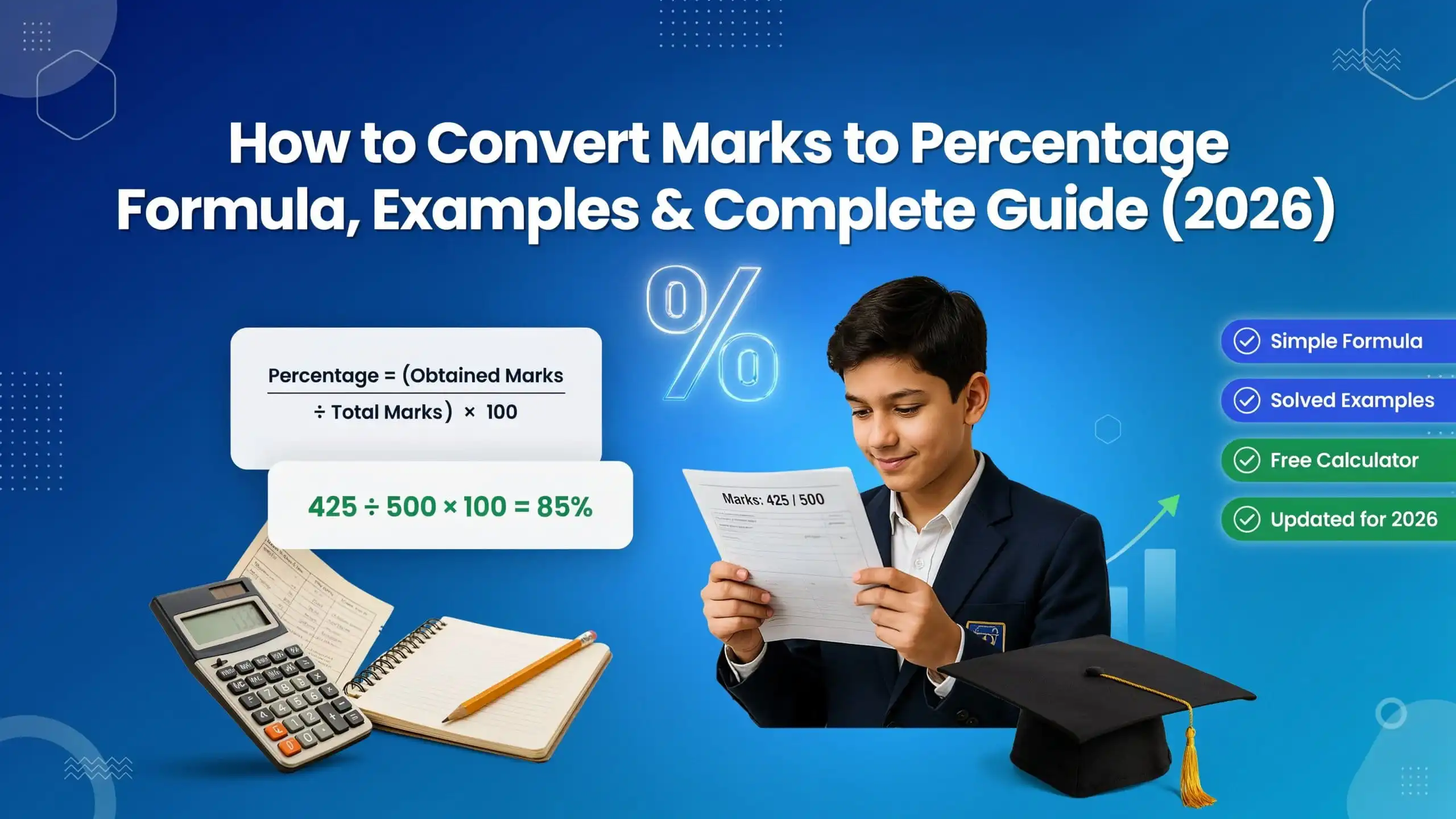
Percentage = (Marks Obtained ÷ Total Marks) × 100
Example: 420 marks out of 500 → (420 ÷ 500) × 100 = 84%
Board-specific rules below (CBSE, ICSE, ISC, state boards, Pakistani boards) are checked against official board circulars and updated as marking policies change.
Got a semester SGPA instead of raw marks? Use the SGPA to percentage calculator. On a 4.0 or 10.0 GPA scale? Check the GPA to percentage guide.
Table of Contents
What Is Percentage of Marks?
Percentage of marks is a way of expressing your academic score as a proportion out of 100. It tells you — and anyone reviewing your application — what fraction of the total available marks you actually earned.
A student who scored 360 out of 500 earned 72% of the total marks available. A student who scored 85 out of 100 earned 85%. Both figures are percentages — they just come from different total marks.
This standardization is why percentage is so widely used. It lets universities, employers, and scholarship boards compare students from different exams, different boards, and different subject combinations on the same scale.
The Core Formula: Marks to Percentage
Percentage = (Marks Obtained ÷ Total Marks) × 100
This single formula handles most situations. Here is what each part means:
- Marks Obtained — the score you actually received
- Total Marks — the maximum possible marks for that exam or subject
- × 100 — converts the decimal ratio into a percentage
Single Subject Example
Marks obtained: 78 Total marks: 100 Percentage = (78 ÷ 100) × 100 = 78%
When the Total Is Not 100
Marks obtained: 68 Total marks: 80 Percentage = (68 ÷ 80) × 100 = 85%
The exam does not need to be out of 100 for the formula to work. The formula converts any marks-to-total ratio into a percentage automatically.
How to Calculate Percentage for Multiple Subjects
This is where most guides give you the formula and move on — but the multi-subject calculation is where students actually make mistakes on formal forms.
The correct method for multiple subjects:
Percentage = (Sum of All Marks Obtained ÷ Sum of All Total Marks) × 100
Do not calculate percentage for each subject separately and then average those percentages. That produces the wrong answer whenever subjects have different total marks.
Example — 5 Subjects, Same Total (100 each)
| Subject | Marks Obtained | Total Marks |
| Mathematics | 88 | 100 |
| Physics | 74 | 100 |
| Chemistry | 81 | 100 |
| English | 79 | 100 |
| Computer Science | 92 | 100 |
| Total | 414 | 500 |
Percentage = (414 ÷ 500) × 100 = 82.8%
Example — Subjects with Different Totals
This is the situation students often mishandle:
| Subject | Marks Obtained | Total Marks |
| Theory Paper | 72 | 100 |
| Practical | 28 | 30 |
| Project | 18 | 20 |
| Total | 118 | 150 |
Percentage = (118 ÷ 150) × 100 = 78.67%
If you had calculated each component separately — 72%, 93.3%, 90% — and averaged them, you would get 85.1%. That is wrong. Always add marks, then divide by total marks.
Step-by-Step: How to Convert Marks to Percentage
Step 1 — Collect Your Marks
Write down the marks you obtained in each subject or paper, along with the maximum marks for each. Use your official marksheet — not estimated marks.
Step 2 — Add Up All Marks Obtained
Sum every subject’s marks obtained into one total figure.
Step 3 — Add Up All Total Marks
Sum every subject’s maximum marks into one total figure.
Step 4 — Apply the Formula
Divide total marks obtained by total maximum marks. Multiply by 100.
Step 5 — Round Off Correctly
Most formal applications accept two decimal places. Do not round up near cutoff values — 64.8% is not 65%. Report the exact calculated figure unless an institution’s specific policy says otherwise.
Use the free Grade Converter at AIHomeworkHelps to verify your calculation before submitting any important form.
CBSE Marks to Percentage Calculation
CBSE Class 10 and Class 12 have specific rules that differ slightly from a simple marks total.
CBSE Class 10
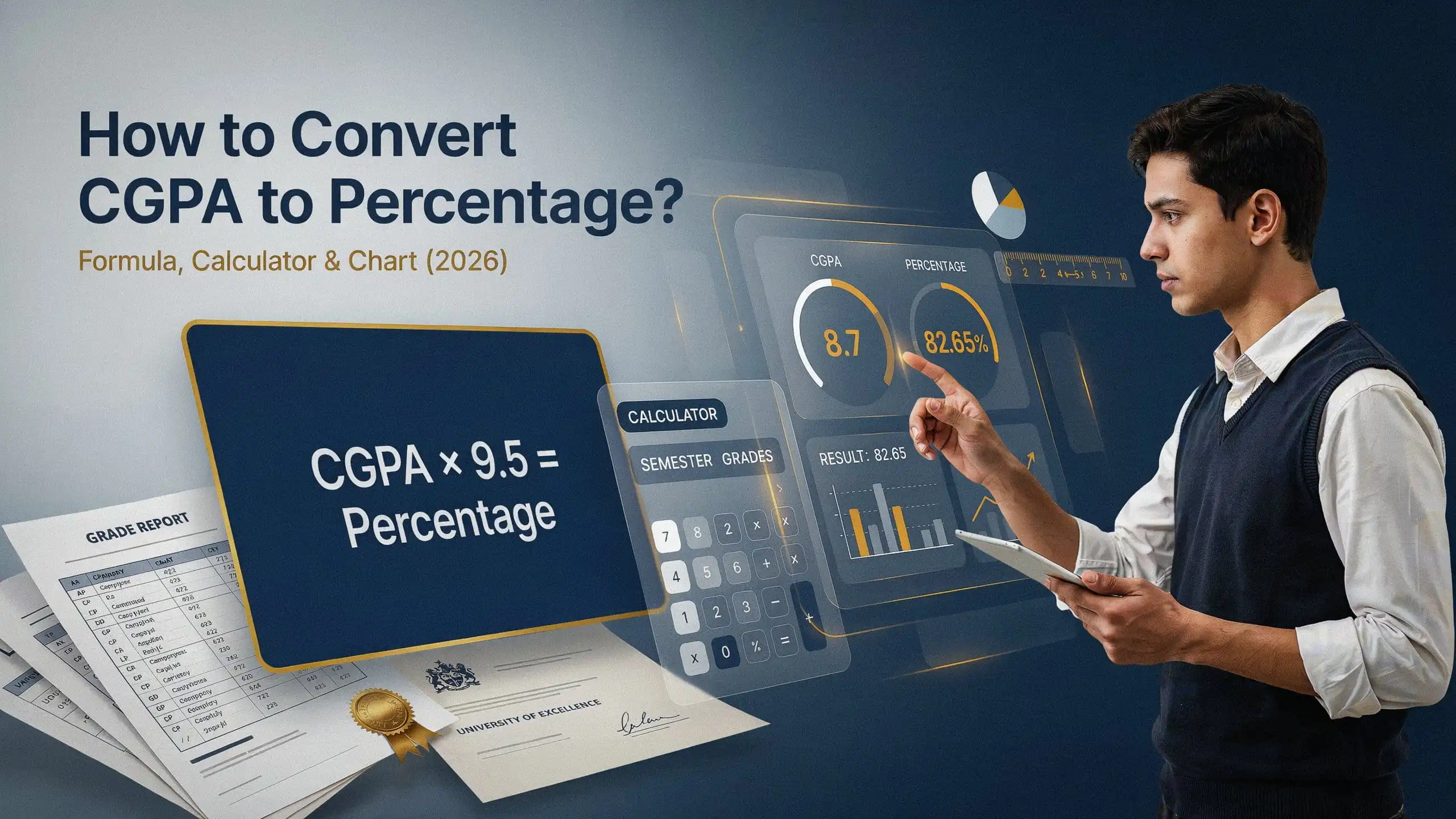
CBSE Class 10 results are issued as CGPA (not percentage). To convert CGPA to percentage, use: Percentage = CGPA × 9.5
If you need percentage from actual marks (for schools that issue marks directly), use the standard formula: (Total Obtained ÷ Total Maximum) × 100.
Best of Five Rule (Class 10): CBSE Class 10 percentage for admission purposes is typically calculated using the best five subjects — including one language and four electives. The language subject is mandatory in the five. Check the specific admission policy of the institution you are applying to, as some require all six subjects to be included.
CBSE Class 12
CBSE Class 12 percentage is calculated across five main subjects. If a student has six subjects, the best five are typically used for percentage calculation — but this depends on the college or program you are applying to.
Practical and Theory Components: For subjects with theory and practical components, both marks are combined before percentage calculation. Do not calculate theory percentage and practical percentage separately.
Example:
- Physics Theory: 62 out of 70
- Physics Practical: 27 out of 30
- Combined: (62 + 27) ÷ (70 + 30) × 100 = 89 ÷ 100 = 89%
Board-Specific Percentage Calculation Methods
ICSE (Class 10)
ICSE calculates percentage using the best five subjects. For most school admissions and competitive exam registrations, ICSE students use the average of their best five subjects. Each subject is typically out of 100.
ISC (Class 12)
ISC uses all subjects. English is compulsory. Percentage is calculated by dividing total marks obtained across all papers by total maximum marks.
State Boards
Most Indian state boards use the standard formula: (Total Obtained ÷ Total Maximum) × 100 across all subjects. Practical marks are typically included. Verify your specific board’s official method from your marksheet legend or board website.
Pakistan Board (BISE, HSC, SSC)
Pakistani boards (BISE Lahore, BISE Karachi, etc.) issue marks directly. Percentage is calculated as (Marks Obtained ÷ Total Marks) × 100 across all subjects. Aggregate calculation for medical and engineering admissions (MDCAT, ECAT) uses a weighted formula combining board percentage and entry test score — verify the current year’s weightage from the respective authority.
Aggregate Percentage vs Subject-Wise Percentage
These are two different things and they are required in different situations. Confusing them on an application form is a common error.
Subject-wise percentage is the percentage in one individual subject: (Marks in that subject ÷ Total marks for that subject) × 100
Aggregate percentage is your overall percentage across all subjects combined: (Sum of all marks obtained ÷ Sum of all total marks) × 100
When a university says “minimum 60% in Mathematics” — they mean subject-wise percentage. When an employer says “minimum 60% in graduation” — they mean aggregate percentage. When a scholarship form says “minimum 75% in 12th class” — they almost always mean aggregate percentage.
Always read the eligibility criteria carefully to know which one is being asked for.
Reverse Calculation: Marks Needed to Achieve a Target Percentage
Sometimes you know the percentage you need and want to calculate how many marks you must score on a remaining exam or paper.
Formula:
Required Marks = (Target % ÷ 100) × Total Marks
Example: You need 75% in an exam worth 80 marks. Required Marks = (75 ÷ 100) × 80 = 60 marks
Multi-subject scenario — marks needed in remaining subjects:
You have already appeared in 4 out of 5 subjects in a 500-mark examination. Your total so far is 310 out of 400. The fifth subject is out of 100. You need 70% overall.
Target total marks = (70 ÷ 100) × 500 = 350 Marks already secured = 310 Marks needed in 5th subject = 350 − 310 = 40 out of 100
This reverse calculation is useful for planning performance in remaining exams.
Percentage to Marks: Reverse Conversion
If you know your percentage and need to find out how many marks that corresponds to:
Marks Obtained = (Percentage ÷ 100) × Total Marks
Example: 78% in an exam out of 150 marks Marks Obtained = (78 ÷ 100) × 150 = 117 marks
Marks to Percentage Conversion Table
Quick reference for common marks-out-of-100 scenarios:
| Marks (out of 100) | Percentage | Grade (General) |
| 90–100 | 90–100% | Outstanding / O |
| 80–89 | 80–89% | Excellent / A+ |
| 70–79 | 70–79% | Very Good / A |
| 60–69 | 60–69% | Good / B+ |
| 50–59 | 50–59% | Average / B |
| 40–49 | 40–49% | Pass / C |
| 33–39 | 33–39% | Pass (Minimum) |
| Below 33 | Below 33% | Fail |
For exams not out of 100, use the formula. The grade labels above reflect general UGC conventions — your institution may use different cutoffs for each grade band.
Marks to Percentage for Common Total Marks
| Marks Obtained | Out of 500 | Out of 600 | Out of 900 |
| 360 | 72% | 60% | 40% |
| 400 | 80% | 66.67% | 44.44% |
| 420 | 84% | 70% | 46.67% |
| 450 | 90% | 75% | 50% |
| 480 | 96% | 80% | 53.33% |
| 500 | 100% | 83.33% | 55.56% |
| 540 | — | 90% | 60% |
| 600 | — | 100% | 66.67% |
| 720 | — | — | 80% |
| 810 | — | — | 90% |
Real Student Scenarios — Where This Matters
Scenario 1: Ananya’s Admission Form Gets It Wrong
Ananya scored 414 out of 500 in Class 12. Her friend told her to add up the five percentages and divide by 5. She got: (88 + 74 + 81 + 79 + 92) ÷ 5 = 82.8%.
By coincidence, this gave the right answer here — because all subjects were out of 100. But if Physics had been out of 70 (with 30 marks in practical), the per-subject average method would have produced a wrong figure. The correct approach is always total obtained ÷ total maximum.
Scenario 2: Ravi’s Engineering Cutoff
Ravi is applying to an engineering program that requires 75% in PCM (Physics, Chemistry, Mathematics). He scored:
- Physics (Theory 70 + Practical 30): 61 + 26 = 87 out of 100 → 87%
- Chemistry (Theory 70 + Practical 30): 58 + 25 = 83 out of 100 → 83%
- Mathematics (Theory 100): 74 out of 100 → 74%
PCM percentage = (87 + 83 + 74) ÷ 300 × 100 = 244 ÷ 300 × 100 = 81.33%
He clears the 75% cutoff. Had he calculated incorrectly and worried about his 74% in Maths in isolation, he might have assumed he did not qualify.
Scenario 3: Hamza’s MDCAT Aggregate (Pakistan)
Hamza scored 850 out of 1100 in his FSc exams. The MDCAT aggregate formula in Pakistan uses: 40% weightage to FSc percentage + 60% weightage to MDCAT score.
FSc percentage = (850 ÷ 1100) × 100 = 77.27%
FSc contribution to aggregate = 77.27 × 0.40 = 30.91%
This is how his board marks feed into the aggregate — not as a raw number, but as a percentage first. Getting the percentage wrong at this step produces a wrong aggregate, which affects college allocation.
Scenario 4: Pooja Plans Her Final Semester
Pooja has appeared in 5 out of 6 semesters in her B.Com program. Her total marks so far are 2,340 out of 3,000. The final semester is worth 600 marks. She wants to finish with 75% overall.
Total marks for full program: 3,600 Target: (75 ÷ 100) × 3,600 = 2,700 Already secured: 2,340 Marks needed in final semester: 2,700 − 2,340 = 360 out of 600 = 60%
She only needs 60% in her final semester to reach 75% overall. This reverse calculation helped her plan her preparation realistically.
How to Convert Marks to Percentage vs How to Convert CGPA to Percentage
These are two different starting points and students often confuse them.
You have raw marks (e.g., 414 out of 500) → use: (Marks ÷ Total) × 100
You have CGPA (e.g., 8.2 on a 10-point scale) → use: CGPA × university multiplier (9.5 or 10)
If your university issues CGPA instead of raw marks on your transcript, your marks have already been converted to grade points. In that case, you cannot reverse-engineer original marks from CGPA — you convert CGPA to percentage directly using your university’s formula.
For the full CGPA conversion guide: How to Convert CGPA to Percentage.
For understanding CGPA vs SGPA: Difference Between CGPA and SGPA.
Common Mistakes When Converting Marks to Percentage
Averaging percentages instead of summing marks The most frequent error. Add all marks obtained, add all total marks, then divide. Never average the individual subject percentages when subjects have different totals.
Using estimated marks instead of official marks Always use the marks on your official marksheet. Estimated or self-assessed marks can differ from official results and create discrepancies during verification.
Forgetting practical marks For subjects with theory + practical components, both must be included in the calculation. A student who includes only theory marks will get a lower percentage than their actual result.
Rounding up near cutoffs 64.8% is not 65%. Report the exact calculated figure. Inflated self-reported percentages get caught during transcript verification.
Including the wrong subjects Some boards and institutions calculate percentage using “best of five” or specific mandatory subjects. Check which subjects are included before calculating.
Benefits of Using a Free Marks to Percentage Calculator
Manual calculation using the formula is reliable and takes less than a minute. But when you have six or more subjects with different total marks, and you are calculating for a high-stakes application, one arithmetic error is all it takes.
The free Grade Converter at AIHomeworkHelps handles single-subject, multi-subject, and aggregate percentage calculations instantly. It supports different total marks across subjects, shows the formula used, and gives you a result you can verify before submitting any important form.
Final Thought
Converting marks to percentage is one of the most fundamental calculations a student makes — and yet it is also one where errors show up regularly on formal applications. The formula itself takes seconds. The errors come from averaging instead of summing, excluding practical marks, or rounding up near cutoffs.
Use the correct method — total obtained divided by total maximum, multiplied by 100 — and verify your result with the free Grade Converter at AIHomeworkHelps before submitting any job application, scholarship form, or admission document.
Frequently Asked Questions
How do you convert marks to percentage?
Divide marks obtained by total marks and multiply by 100. Formula: (Marks Obtained ÷ Total Marks) × 100. For multiple subjects: add all marks obtained, add all total marks, then apply the formula to the totals.
How do I calculate percentage for 5 subjects?
Add the marks obtained in all 5 subjects. Add the total maximum marks for all 5 subjects. Divide obtained by maximum and multiply by 100.
Can I calculate percentage if subjects have different total marks?
Yes. The formula works regardless of whether subjects have the same or different total marks. Simply sum all marks obtained and sum all total marks, then divide. Do not average subject-wise percentages.
What is the difference between marks and percentage?
Marks are the raw score (e.g., 85 out of 100). Percentage converts that score to a proportion out of 100, allowing fair comparison across different exams and maximum marks.
How do I convert CBSE Class 10 CGPA to percentage?
CBSE Class 10 uses CGPA, not raw marks. Use: Percentage = CGPA × 9.5. Example: 8.4 CGPA × 9.5 = 79.8%.
How do I find out how many marks I need to get a specific percentage?
Use: Required Marks = (Target % ÷ 100) × Total Marks. Example: to get 75% in a 200-mark exam, you need (75 ÷ 100) × 200 = 150 marks.
What is 420 out of 500 in percentage?
(420 ÷ 500) × 100 = 84%
What is 360 out of 500 in percentage?
(360 ÷ 500) × 100 = 72%
What is 450 out of 600 in percentage?
(450 ÷ 600) × 100 = 75%
What is 810 out of 1200 in percentage?
(810 ÷ 1200) × 100 = 67.5%