
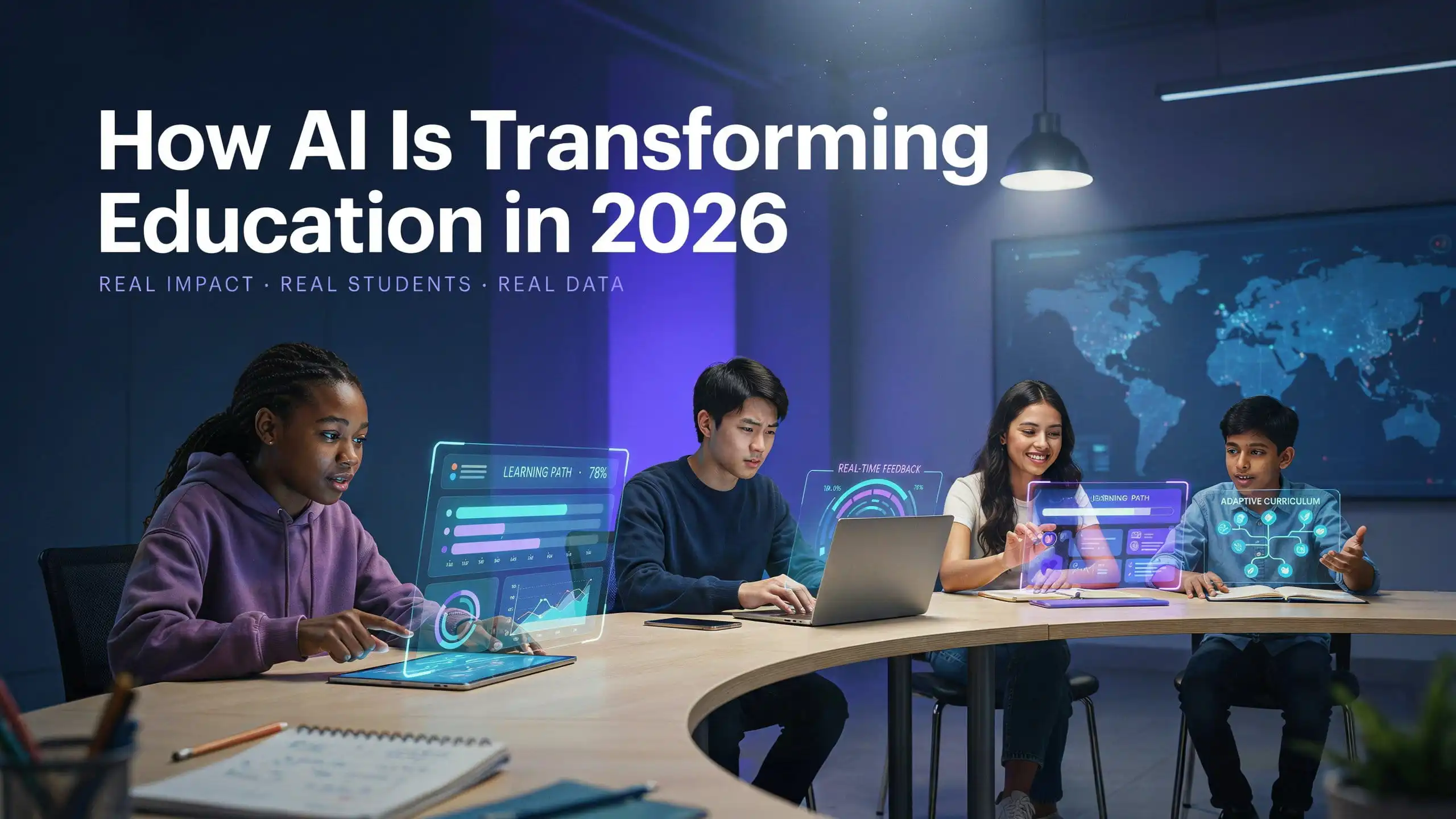
Something quietly changed in classrooms around the world between 2023 and 2026.
It was not a single announcement. It was not one platform going viral. It happened gradually — a student here asking an AI to explain a concept at midnight, a teacher there using it to grade a set of worksheets, a school administrator pulling AI-generated attendance analytics instead of counting by hand.
By 2026, the question is no longer whether AI has changed education. The data has answered that. The question now is whether those changes are making students genuinely smarter — or just more efficient at appearing that way.
This guide examines what is actually happening, who it affects, and what to do about it.
Table of Contents
What Is Artificial Intelligence in Education?
Artificial intelligence in education refers to computer systems that can understand questions, analyze learning behavior, generate explanations, grade work, and adapt content in real time — without needing the same instruction twice.
The older definition of educational software was: a program follows fixed rules. You press this button, this thing happens. AI is different. A modern educational AI does not follow a script. It reads what a student types, understands the intent behind the question, identifies what the student likely does and does not know, and generates a response that meets them at their level.
The technology that powers most of these systems in 2026 is the large language model — the same class of model behind tools like Claude, Aihomeworkhelps, GPT-4, and Google’s Gemini. These models were trained on enormous amounts of text and developed the ability to reason about language in ways that earlier software could not.
For education, this matters because most learning happens through language. Explanations, questions, feedback, essays, problem statements — all of it is language. A system that genuinely understands language can participate in that process in a way earlier software never could.
What AI in education is not: it is not a replacement for the human relationships that make learning meaningful. It is not infallible. And it is not yet equally accessible to every student on earth. Understanding all three of those limitations matters as much as understanding the capabilities.
The Numbers That Frame Everything Else
Before going into specifics, here is the factual baseline for 2026.
According to a 2025 report by the Center for Democracy and Technology, 85% of teachers and 86% of students used AI tools during the previous school year. The OECD’s Digital Education Outlook 2026 described AI in classrooms as no longer “arriving” — it has arrived, and the challenge has shifted from adoption to guidance.
The global AI in education market stood at approximately $7 billion in 2025 and is projected to reach $112 billion by 2034, growing at roughly 36% per year. The adaptive learning segment alone reached $4.59 billion by February 2026.
Perhaps the most telling number: in a January 2026 survey by the American Association of Colleges and Universities, 95% of college faculty said they were worried about student overreliance on AI reducing critical thinking. That is not a fringe concern. When 95% of educators share a worry, it is the dominant story in the room.
How AI Is Currently Being Used in Educational Settings
Personalized Learning Experiences
The most significant structural shift AI brings to education is the collapse of the one-pace-fits-all classroom.
Traditional instruction gives every student in a room the same lesson at the same speed. That model has a built-in problem: some students are bored because the pace is too slow; others are lost because it is too fast. The students who suffer most are the ones at both ends of that spectrum — the ones who need more time and the ones who could move faster.
AI-powered platforms track individual performance continuously. They see which concepts a student understands on the first attempt, which require three explanations, and which keep getting wrong answers regardless of how many times the student tries. Then they adjust — giving more practice where it is needed, skipping review where it is not.
Real-Life Example:
Zara is a 14-year-old in Manchester studying for her GCSEs. She is strong in biology but consistently scores below average in chemistry stoichiometry. Her school uses an AI learning platform that detects this pattern after two weeks of practice sessions.
Without saying anything to Zara, the platform begins prioritizing stoichiometry problems in her daily practice queue, varies the way they are presented, and introduces a visual simulation of molecular ratios alongside the numerical problems. Three weeks later, Zara’s stoichiometry scores have improved by 31%. Her teacher did not change what she was teaching. The AI changed when and how Zara encountered the material.
This is personalized learning at scale — something that would require an individual tutor for each student to achieve through human instruction alone.
24/7 Learning Support — The Midnight Tutor Effect
One of the most underappreciated changes AI has brought to education is not about what students learn — it is about when.
Before AI homework tools existed, a student stuck on a problem at 11 PM had two options: leave it and move on, or stare at the textbook until frustration won. Neither produced learning.
Now that student has a third option: ask. The AI is available at midnight, on weekends, during school holidays, and on the day before an exam when every human tutor is already fully booked.
Real-Life Example:
Kofi is a 17-year-old in Accra, Ghana. He is the first in his family pursuing university entrance. His physics teacher is excellent but has 48 students in one class — there is no realistic way to get individual help after school hours.
The night before his physics mock exam, Kofi cannot understand how to apply Newton’s second law to two-body problems. He opens an AI tool at 10:30 PM. Over the next 45 minutes, the AI walks him through the concept using three different approaches, generates five practice problems, and checks his working. By midnight, Kofi understands it well enough to solve variations he has never seen before.
He passes the mock exam. The AI did not teach him physics. It was available when his teacher could not be.
This kind of around-the-clock support matters most in contexts where access to quality tutors is limited by geography or cost. To explore the specific tools that provide this kind of support most effectively, the guide on what AI homework help is and how it actually works breaks down the mechanics clearly.
Smart Content Creation and Auto-Grading
Two tasks that consumed enormous amounts of teacher time in traditional education were creating assessment materials and marking them. AI has changed both.
On the content creation side, a teacher who previously spent three hours writing a practice test can now generate a draft in minutes — including questions at different difficulty levels, answer keys, and worked solutions. The teacher still decides what goes in the final version, but the starting point is no longer a blank page.
On the grading side, AI can assess multiple choice answers, short numerical responses, and increasingly, structured written responses — flagging not just whether the answer is correct but identifying the specific type of error the student made.
Real-Life Example:
Ms. Patel teaches Year 9 science at a secondary school in Birmingham with 180 students across five classes. Every fortnight, she gives a short assessment — 180 papers to mark manually, usually consuming her entire Sunday.
After her school adopted an AI-assisted grading platform, that process changed. The AI marks each paper, categorizes errors by type (conceptual misunderstanding vs. calculation error vs. incomplete answer), and generates a class-level report showing which concepts most students got wrong. Ms. Patel reviews the flagged edge cases — where the AI is uncertain — and spends Sunday afternoon doing targeted re-teaching prep instead of marking.
She now has time to contact three parents whose children are consistently struggling, something she never had bandwidth for before.
Auto-grading does not replace teacher judgment. It removes the mechanical work so that teacher judgment can go where it actually matters.
Assessment and Feedback — Speed Changes Everything
Research on learning has consistently shown that the timing of feedback dramatically affects whether a student corrects a mistake or ingrains it. Feedback given immediately after an error — while the problem is still live in working memory — produces better learning outcomes than the same feedback given days later.
AI makes immediate feedback structurally possible in a way that human grading cannot.
When a student completes an AI-assisted practice problem and gets it wrong, the correction arrives in seconds — with an explanation of what went wrong and why. There is no wait. The error does not calcify. The correction lands while the student is still thinking about the problem.
This is not a small advantage. It is a fundamental change in how learning consolidates.
Language Learning and Accessibility
AI has moved language learning from a schedule-dependent activity to an always-available conversation partner.
Traditional language learning required either a human conversation partner, an expensive in-person course, or passive repetition with flashcard apps. AI language tools now provide genuine interactive practice — responding naturally to what the learner says, correcting errors without judgment, adjusting to the learner’s level, and maintaining conversation on any topic the learner chooses.
For students with accessibility needs, AI has made adaptive learning interfaces significantly more practical. Speech-to-text for students who cannot easily type. Text-to-speech for students who process audio more easily than text. Real-time translation for students learning in a non-native language. Adjustable interface complexity for students with cognitive differences.
Real-Life Example:
Miguel is a 16-year-old who moved from Mexico City to Toronto three years ago. His English is conversational but not academic — he struggles with written comprehension in his history class. His school uses an AI tool that can present history content in simplified English with embedded vocabulary support and optional Spanish translation for key terms.
In his first year, Miguel’s history teacher spent significant class time translating concepts for him individually. In his second year with the AI tool, Miguel works through content at his own reading level and flags the moments where he genuinely needs human clarification. His teacher now focuses those interactions on depth rather than translation.
Miguel’s history grade improved from a C- to a B+ over two academic years. The AI did not make him a better historian — it removed the language barrier long enough for him to demonstrate that he already was one.
Virtual Reality and Augmented Reality in Education
VR and AR are not new to education, but in 2026 they have matured from expensive novelties into practical tools in specific subject areas.
The combination of AI and immersive technology is particularly powerful because AI can personalize the experience inside a virtual environment — not just presenting the same simulation to every student, but adapting difficulty, pacing, and focus based on how the student is interacting.
Medical students perform simulated surgeries in virtual operating rooms where the AI adjusts the complexity of complications based on their demonstrated competency. Engineering students explore digital models of structures under load conditions that would be impossible to replicate physically. History students walk through reconstructed environments of ancient Rome, not as passive observers but as participants whose interactions with the environment generate learning feedback.
Research published in 2026 found that AI-driven simulations accelerate skill mastery by up to four times compared to traditional lecture-based learning in hands-on technical domains — a gap that is difficult to close through any other means at comparable cost.
The realistic assessment for most schools in 2026: full VR integration is still limited by hardware cost and infrastructure. But AR tools running on standard tablets and phones are increasingly accessible, and the AI-powered simulation layer is becoming standard in higher education and technical training programs.
Intelligent Tutoring Systems — Beyond Basic Chatbots
An intelligent tutoring system is specifically designed to replicate the pedagogical function of a human tutor — not just answering questions, but identifying where a student’s reasoning breaks down and addressing the specific source of the confusion.
By 2026, these systems have evolved beyond basic chatbots. Modern learning agents use the Socratic method — questioning, nudging, and adjusting their strategy based on the learner’s responses — rather than simply delivering information.
The distinction matters. A basic AI tool gives you the answer to a maths problem. An intelligent tutoring system asks you what you think the first step should be, evaluates your reasoning, and guides you to discover the correct approach rather than simply showing it to you.
This approach is pedagogically superior because students who construct understanding through guided discovery retain it significantly longer than students who receive the same information directly. The challenge is that it requires more sophisticated AI — one that can model not just the correct answer but the student’s current state of understanding.
Real-Life Example:
Aisha, a 16-year-old in Karachi, is using an intelligent tutoring platform for her A-level mathematics preparation. She attempts a trigonometry problem and gets it wrong. Instead of showing her the solution, the system asks: “What formula did you use for the first step?” Aisha types her answer. The system identifies that she has confused sine and cosine rules and responds: “You’ve used the right approach for a different type of triangle. Can you tell me what information you have about this triangle’s angles versus sides?”
Through four exchanges, Aisha works out the error in her own reasoning. She does not see a worked solution until after she has identified the mistake herself. Two weeks later, she correctly solves a more complex variation of the same problem type on her own. The AI did not give her the answer. It gave her the thinking process.
Who Should Learn About AI in Education?
The transformation of education through AI is not a topic only for teachers or computer scientists. It matters differently to every person who interacts with educational systems.
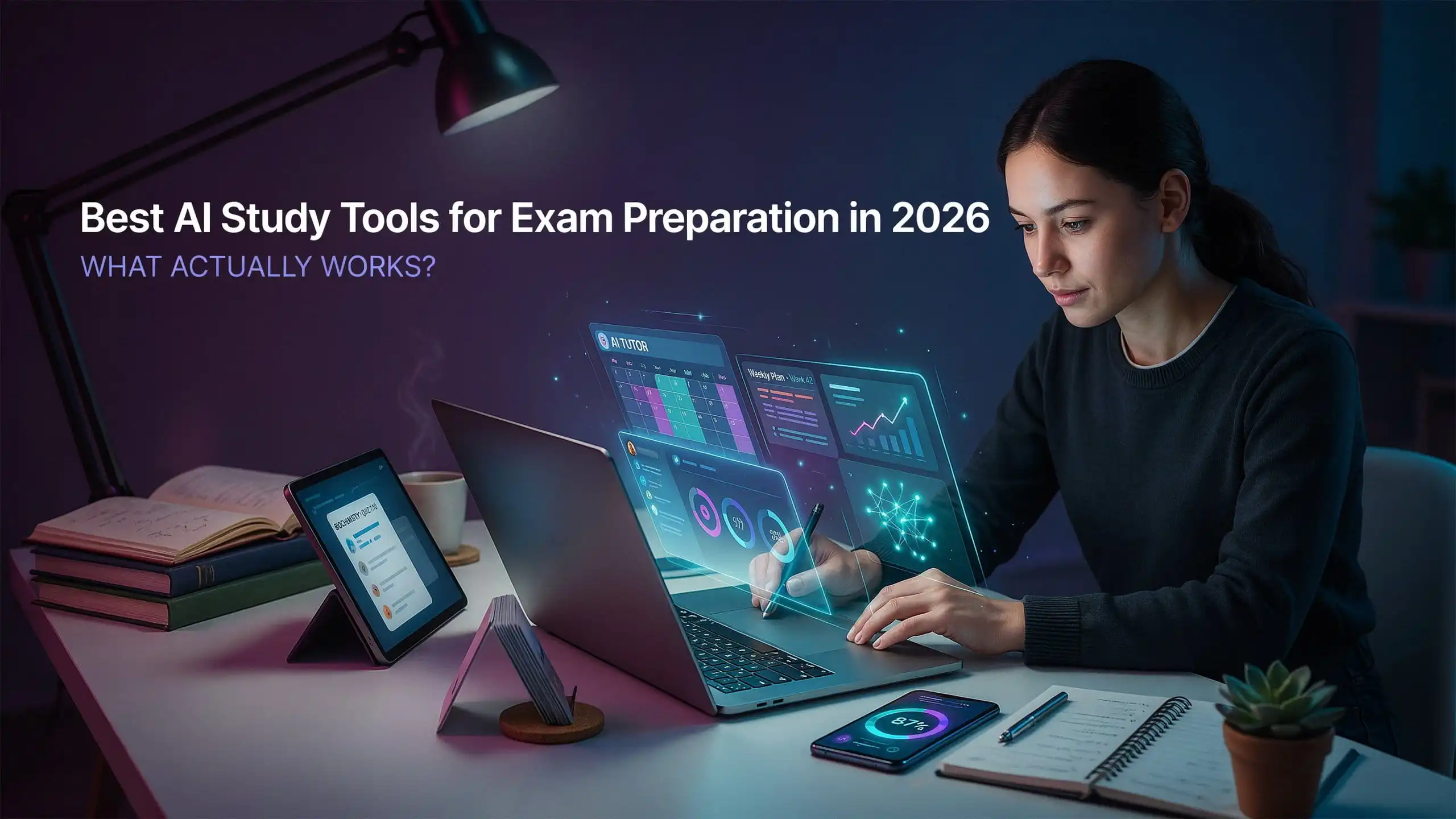
Students are the most directly affected. AI tools are available to students right now, changing how they can study, practice, and prepare for exams. Understanding how to use these tools effectively — and when not to rely on them — is already a practical skill with immediate consequences for academic performance. Students preparing for competitive examinations will find targeted guidance in the article on the best AI study tools for exam preparation in 2026.
Teachers are experiencing a fundamental shift in what their job involves. AI is removing the most repetitive parts of teaching — generating materials, marking routine assessments, tracking individual progress — and freeing time for the parts that require human judgment: mentoring, facilitating discussion, identifying struggling students early, and building the relationships that make students want to learn.
Parents are watching their children use tools that did not exist when they were in school and trying to decide what constitutes appropriate use. Understanding what AI education tools actually do — and what the research says about their effects — equips parents to have better conversations with their children and with schools about responsible use.
School administrators are making institutional decisions about which platforms to adopt, how to address academic integrity, how to handle student data, and how to train staff. These decisions have long-term consequences for thousands of students and require a baseline understanding of both the capabilities and the risks.
EdTech professionals and developers are building the tools that will shape how the next generation learns. Understanding the pedagogical principles that make AI education tools effective — not just the engineering — is critical to building products that actually improve outcomes rather than just measuring engagement.
Key Considerations and Challenges
Data Privacy and Security
Every AI education platform that personalizes learning is collecting data about students. It has to — personalization is not possible without information about what the student does and does not understand. The question is what happens to that data beyond its educational function.
UNESCO’s September 2025 report on AI and education called explicitly for a human-centred, rights-based approach, arguing that AI and digitalization must be anchored in human rights and noting that vulnerable groups still lack connectivity and face compounded digital risks.
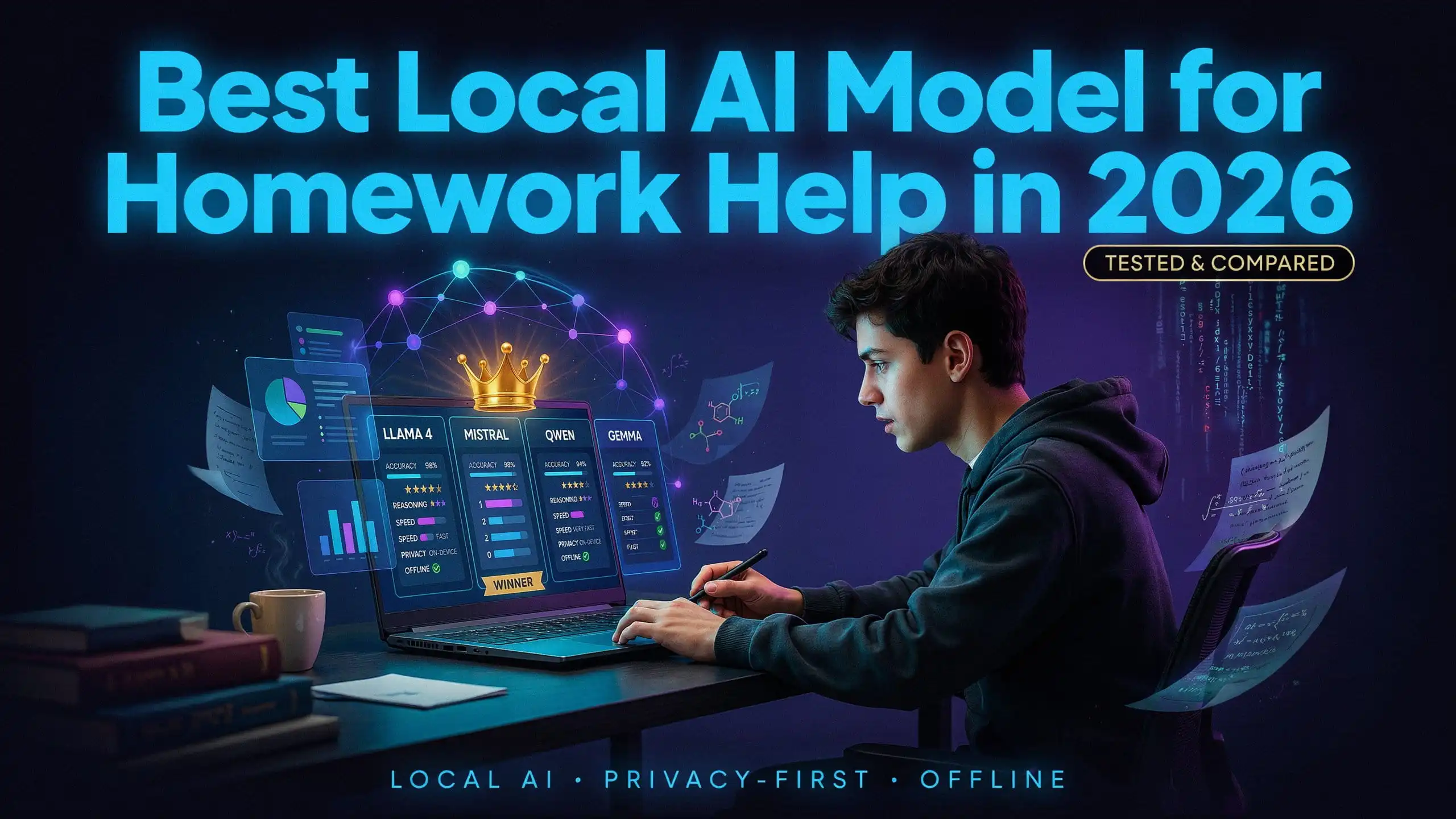
For students and parents, the practical implication is straightforward: read the privacy policy of any AI education tool before using it with real academic work. Avoid entering personally identifiable information into platforms with unclear data practices. Where data privacy is a genuine concern, locally-run AI tools that process information on the device rather than sending it to external servers are worth considering. The guide on which local AI model works best for homework help covers this option in detail.
Algorithmic Bias
AI systems learn from the data they are trained on. If that data reflects existing inequalities — underrepresentation of certain demographics, historical biases in curriculum, cultural assumptions embedded in language — the AI can reproduce and sometimes amplify those inequalities.
In practical terms for students: an AI that was trained predominantly on content from one cultural or linguistic context may not explain concepts in ways that resonate equally well with students from different backgrounds. An AI grading system trained on essays from one demographic group may evaluate essays from another group differently.
This does not mean AI tools are unusable — it means they require critical engagement. Students should treat AI outputs as a starting point for understanding, not a final authority, and should cross-check important information against sources that are known to be reliable and appropriate for their context.
The Digital Divide — The Inequality Nobody Advertises
According to OECD 2026 data, high-income countries accounted for 60% of generative AI use in education in 2025, while low-income countries accounted for less than 1%.
This is the most significant structural problem in AI education, and it does not get enough attention in guides written primarily for students in high-income contexts.
The students who stand to benefit most from AI education tools — those in under-resourced schools with large class sizes, limited teacher availability, and few extracurricular learning options — are frequently the students with the least access to the hardware and connectivity required to use those tools.
UNESCO noted that approximately 2.6 billion people still lack internet access, making the most powerful AI education tools structurally inaccessible to a large portion of the world’s students. The technology exists to help them. The infrastructure often does not.
This is a policy problem, not a technology problem. And its progress is slower than the technology’s.
The Human Element — What AI Cannot Simulate
There is a tendency in discussions of AI in education to focus on what AI can do and underemphasize what it cannot.
AI cannot notice that a student who was performing well has suddenly gone quiet and investigate why. It cannot read the room when a class is confused but reluctant to admit it. It cannot build the kind of trust with a struggling student that makes them willing to try again after a humiliating failure. It cannot inspire.
The CDT’s 2025 report found that 69% of teachers said AI tools gave them more time to interact directly with students — which is arguably the most important thing that report revealed. AI’s most significant contribution to teaching may not be what it does, but what it frees teachers to do more of.
The 95% of college faculty who are worried about student overreliance on AI are not technophobes. They are people who understand that the things AI cannot do — independent thinking, sustained effort, intellectual resilience — are the things education exists to develop. Tools that make students better at appearing capable without becoming capable are not beneficial, regardless of how sophisticated the underlying technology is.
AI Tools Currently Used in Education
Here is an honest overview of the categories of AI tools that are in active use across educational settings in 2026, and what each actually does.
| Tool Category | What It Does | Best Used For | Limitations |
| AI Homework Help | Step-by-step explanations of academic problems | Unstuck moments, concept review | Can produce errors; verifying answers is essential |
| Intelligent Tutoring Systems | Adapts explanation to student’s specific confusion, uses Socratic questioning | Deep concept learning, exam prep | Requires student engagement; doesn’t work passively |
| Adaptive Learning Platforms | Tracks performance, adjusts content difficulty and topic focus | Long-term subject mastery | Works best with consistent daily use |
| Auto-Grading Systems | Marks assessments, categorizes errors, generates class reports | Teacher efficiency, faster feedback | Less accurate on subjective or nuanced written work |
| AI Writing Assistants | Checks grammar, suggests structure, flags unclear arguments | Essay development, academic writing | Not a substitute for original thinking |
| Language Learning AI | Conversation practice, pronunciation feedback, vocabulary adaptation | Language acquisition at any level | Accent and dialect training still limited |
| VR/AR Learning Environments | Immersive simulations for technical subjects | Medical, engineering, historical learning | Hardware cost limits access |
| AI Study Planners | Creates revision schedules, spaced repetition queues, practice test banks | Exam preparation | Requires accurate self-assessment input from student |
| Career Guidance AI | Analyzes student strengths and interests, maps to career paths and skill gaps | Post-school planning, subject selection | General recommendations; not a substitute for human counselling |
AI as Career Counsellor and Skills Navigator
One of the less-discussed applications of AI in education is its growing role in career guidance — an area where traditional educational institutions have often been chronically under-resourced.
Most schools cannot employ enough qualified career counsellors to give every student meaningful individual guidance about their strengths, interests, and options. AI is beginning to fill part of that gap.
Modern AI career tools analyze a student’s academic performance patterns, self-reported interests, extracurricular engagement, and declared goals, then generate personalized recommendations about subjects to pursue, skills to develop, and career directions that match their profile.
The World Economic Forum’s 2025 Future of Jobs Report identified AI and Machine Learning Specialists as among the fastest-growing job roles globally through 2030, and AI career platforms are now helping students understand what preparing for those roles actually requires — not in abstract terms, but in specific, actionable skill-building steps.
Real-Life Example:
James is a 17-year-old in London who knows he enjoys problem-solving but has no idea what career direction that points toward. His school’s AI career platform analyzes his performance data: consistently high scores in mathematics and computer science, strong marks in economics essays, moderate performance in traditional science subjects. It maps this against real-world career data and suggests three directions: data science, quantitative finance, and product management in tech.
For each path, the platform shows James exactly which A-level and university subjects are most commonly taken by people currently working in those fields, which skills have the highest demand in current job postings, and which entry-level certifications would strengthen his application.
James’s human career counsellor then has a focused conversation with him about those three options rather than an open-ended session trying to figure out where to start. The AI did the groundwork. The human does the guidance.
Gamified Learning — Engagement Without Gimmicks
Gamification in education has a mixed history. When it is done poorly, it is just points and badges layered over the same content — engagement tricks that wear off quickly. When it is done well, it uses the structural elements of games (challenge, progression, immediate feedback, stakes) to create the conditions in which learning actually accelerates.
AI has made effective gamification significantly more achievable because it can personalize the difficulty curve in real time.
In a non-adaptive gamified system, every student faces the same challenges in the same sequence. The student who finds the early challenges trivial gets bored. The student who finds them overwhelming gets discouraged. Both stop engaging.
An AI-powered gamified system adjusts challenge difficulty to the individual student’s current level — always pushing slightly beyond comfort, never so far that progress feels impossible. This is the same principle that makes video games compelling: the challenge matches the player’s skill closely enough that improvement feels achievable.
Research published in 2026 notes that gamification serves best as an engagement hook rather than a long-term retention strategy, and that its effectiveness varies significantly between student demographics and age groups. The lesson from that finding: gamification works when it supports genuine learning, not when it substitutes for it.
The Job Market for AI in Education
For students considering careers in this field, the job market data is clear.
The U.S. job market for AI in education technology is growing by over 25% annually, driven by increased investment in digital learning platforms and automated administrative systems.
The roles emerging in this field are genuinely new — they did not exist five years ago and will not look the same in five more years.
Learning Data Analyst — Interprets AI-generated student performance data to identify trends, predict which students need intervention, and help institutions make evidence-based decisions about curriculum and support.
EdTech Curriculum Designer — Creates AI-enhanced learning materials that adapt to student needs. Requires both subject expertise and an understanding of how AI personalization actually works in practice.
AI Ethics and Policy Specialist in Education — Oversees responsible AI use within institutions: ensuring fairness, protecting student data, and developing guidelines for both teachers and students.
Intelligent Tutoring System Developer — Builds the AI systems that drive personalized learning platforms. Requires programming skills but increasingly also requires pedagogical knowledge — pure software engineers who do not understand how learning works tend to build systems that are technically impressive but educationally limited.
AI Integration Consultant — Helps schools and districts implement AI tools effectively, including teacher training, policy development, and outcome measurement.
Do You Need a Computer Science Degree to Work in This Field?
No — and this is a common misconception worth addressing directly.
The AI in education field needs people with backgrounds in education, psychology, curriculum design, data analysis, policy, ethics, and communication — not just software engineering. Interdisciplinary roles combining AI with cognitive science or behavioral psychology focus on how learners engage with technology, and these roles are often more impactful than pure engineering ones.
A teacher with a strong understanding of how learning works and a willingness to engage seriously with AI tools is more valuable to most EdTech companies than a developer who has never taught.
How Long Does It Take to Build Expertise?
It depends entirely on what kind of expertise and for what role.
A teacher who wants to integrate AI tools effectively into their classroom can develop meaningful competence in a single semester of focused professional development. The tools themselves are increasingly accessible — the learning curve is about pedagogical judgment, not technical skill.
A career in EdTech product development or AI curriculum design typically requires two to four years of combined subject expertise and technical or data skills, often through a combination of existing qualifications and targeted upskilling.
A research career in learning science and AI requires graduate-level study, typically five to seven years from undergraduate entry.
What Is the Job Market Actually Like?
AI skills mentions in U.S. education technology job postings have doubled year-over-year according to Lightcast data — that is a significant signal about where the field is moving.
Entry-level roles in EdTech companies typically start between $65,000 and $89,000 annually in the U.S. market. Senior roles in AI curriculum design, learning analytics, and platform development range considerably higher. Academic and policy roles vary widely by institution.
The honest caveat: it is a fast-moving field, and the specific roles that exist in 2026 may look different in 2029. The skills that retain value longest are the foundational ones — understanding how people learn, how to interpret data honestly, and how to think critically about technology claims.
Is This Field Only About Online Learning?
No, and this is a limitation worth noting in competitor content that implies AI education is synonymous with online education.
AI is transforming in-person classrooms too. AI-powered tools are being used in physical schools to personalize what happens in the room — giving teachers real-time data about which students are struggling with which concepts, generating differentiated exercises that students work on at their own level during class time, and flagging when a student’s participation patterns suggest they may need support.
The physical classroom is not being replaced. It is being informed by better data and supported by tools that handle the mechanical work, freeing teacher attention for the relational and intellectual work that happens face to face.
Preparing for an AI-Integrated Education Landscape
Whether you are a student, a teacher, a parent, or an administrator, the same underlying principle applies: the people who navigate this transition best will be those who engage with AI deliberately rather than either avoiding it or surrendering judgment to it.
For students, this means developing the habit of using AI to understand rather than to avoid understanding. The goal is not to get the answer faster. It is to learn the concept well enough that you no longer need the AI’s help with that particular thing.
For teachers, it means treating AI as a professional tool that handles what it handles well, and protecting the time and energy that AI frees up for the work that only humans can do — building relationships, sparking curiosity, and responding to the specific human being sitting in front of you.
For institutions, it means developing clear, honest policies about AI use that are grounded in educational values rather than either fear or uncritical enthusiasm. The OECD’s 2026 report was explicit: generative AI can support learning when guided by clear teaching principles, but when used without pedagogical support, it enhances performance metrics without producing real learning.
The goal is not AI integration for its own sake. The goal is education. AI is a tool in service of that goal — one that is powerful enough to require careful handling and consequential enough to take seriously.
The Future of AI in Education
AI-Based Global Classrooms
The structural barriers that have always limited international education — distance, language, cost, time zones — are becoming less absolute.
AI-powered real-time translation means a student in Lagos can participate in a seminar led by an instructor in Singapore without either party needing to speak the other’s language. AI tutoring systems mean students in rural areas without access to specialist teachers can receive support in subjects like advanced mathematics or chemistry that their local schools cannot staff.
This is not fully realized in 2026. The infrastructure gaps are real and the digital divide remains severe. But the direction of travel is clear.
AI Career Coach — Ongoing Guidance, Not One-Time Advice
The traditional model of career guidance in schools is a handful of sessions with a counsellor in Years 10 through 13. That is not enough guidance for decisions with multi-decade consequences.
AI career coaching tools are moving toward continuous engagement — monitoring academic performance, industry trends, and skill demand data over time, and flagging when a student’s trajectory suggests they should consider adjusting their path. This is not replacing human career counsellors. It is giving those counsellors much better information and freeing their time for the conversations that require human judgment.
Gamified Learning — What Comes Next
The next generation of gamified education is not about points and badges. It is about creating AI-personalized learning environments where the challenge level, the narrative context, and the feedback loop are all adjusted in real time to keep each individual student in the optimal learning state.
Early research suggests this approach can significantly improve motivation in students who disengage from traditional instruction — particularly students whose learning differences make standard formats less accessible.
The open question is whether these systems can produce genuine deep understanding or whether they optimize for engagement at the expense of the slower, harder work that produces durable knowledge.
A Final Word on What This Transformation Actually Demands
The most honest thing that can be said about AI’s transformation of education in 2026 is this: the technology is more capable than most people expected, the risks are more serious than the promotional materials admit, and the outcome for any individual student depends almost entirely on how they choose to engage with it.
AI makes information more accessible, practice more personalized, and feedback faster. None of those things are trivial. But none of them replace the thing that education has always been fundamentally about: the development of a person’s capacity to think, question, persist, and understand.
That capacity is still built the old-fashioned way — through effort, struggle, curiosity, and the guidance of people who genuinely care whether you grow.
AI is a tool in service of that process. A powerful one. One worth using well.
Frequently Asked Questions
Will AI replace teachers?
No. AI handles information delivery, routine assessment, and personalized practice well. It cannot replicate mentorship, emotional intelligence, classroom management, or the motivational impact of a teacher who genuinely believes in a student. The CDT’s 2025 report found 69% of teachers said AI improved their teaching — they consistently describe it as a tool that freed them for higher-value work, not a competitor.
Do I need a computer science degree to work with AI in education?
No. The field needs educators, psychologists, curriculum designers, data analysts, ethicists, and policy specialists as much as it needs engineers. A teacher with deep pedagogical knowledge and AI literacy is often more valuable to EdTech companies than a developer who has never been in a classroom.
How long does it take to develop expertise in AI education?
For classroom integration, a semester of focused professional development is enough to begin using AI tools effectively. For careers in EdTech product development, two to four years. For research careers in learning science and AI, graduate study of five to seven years. The timeline depends entirely on the goal.
What is the job market like for AI in education careers?
Growing fast. AI skills mentions in education technology job postings have doubled year-over-year in the U.S. Entry-level EdTech roles start at $65,000 to $89,000. The field is broad — roles range from learning data analyst and curriculum designer to AI ethics officer and intelligent tutoring system developer.
Is AI in education only relevant to online learning?
No. AI tools are being actively used in physical classrooms to give teachers real-time data, generate differentiated in-class activities, and flag struggling students early. The classroom is not being replaced — it is being better informed.
What are the biggest risks of AI in education?
Student overreliance on AI at the expense of independent thinking (flagged by 95% of college faculty in January 2026 surveys). The digital divide — 60% of generative AI education use is in high-income countries, while low-income countries account for less than 1%. Data privacy vulnerabilities. And algorithmic bias that can reproduce or amplify existing educational inequalities.