
You have a GPA. A form or an application is asking for a percentage. Or the reverse — you have a percentage and need to express it as a GPA for a foreign university application.
Either way, the conversion is not as universal as most guides suggest. The formula depends entirely on which GPA scale you are working with — 4.0, 5.0, 7.0, or 10.0 — and those four scales give very different results for the same underlying academic performance.
This guide covers every direction and every scale: GPA to percentage, percentage to GPA, Indian CGPA to US GPA, country-specific formulas, WES/ECE evaluation, and exactly how to present your converted score on applications without misrepresenting your academic record.
Quick Answer — GPA to Percentage:
| Your Scale | Formula | Example |
| 4.0 (US, Pakistan HEC) | GPA ÷ 4 × 100 | 3.2 → 80% |
| 5.0 | GPA ÷ 5 × 100 | 4.0 → 80% |
| 7.0 (Australia) | GPA ÷ 7 × 100 | 5.6 → 80% |
| 10.0 (India CGPA) | GPA × 9.5 or × 10 | 8.0 → 76–80% |
These are widely accepted approximation formulas, not a single global standard — for certified conversions, see the WES/ECE section below.
Converting a single semester’s Indian score? Use the SGPA to percentage calculator. Working from raw exam marks instead? Try the marks to percentage calculator.
Table of Contents
What Is GPA and Why Does It Need Converting?
GPA stands for Grade Point Average. It is a numerical summary of academic performance expressed on a fixed scale — most commonly 4.0 in the US and Pakistan, 10.0 in India, 7.0 in Australia, and a reverse 1.0–5.0 scale in Germany where lower is better.
The reason conversion matters is the same across all situations: different systems speak different academic languages. An Indian student applying to a US university needs to express their 10-point CGPA in a format American admissions committees understand. A Pakistani student on the HEC 4.0 scale applying to a UK university needs a percentage equivalent. A US graduate applying for a job in India or the UAE may need to convert their 3.7 GPA into a percentage for an eligibility form.
None of these conversions are officially standardized — no single global authority dictates a universal formula. What exists are widely accepted approximations that work well for most purposes, alongside formal credential evaluation services for situations where an official conversion is required.
GPA to Percentage: Formula by Scale
4.0 Scale (US, Canada, Pakistan HEC)
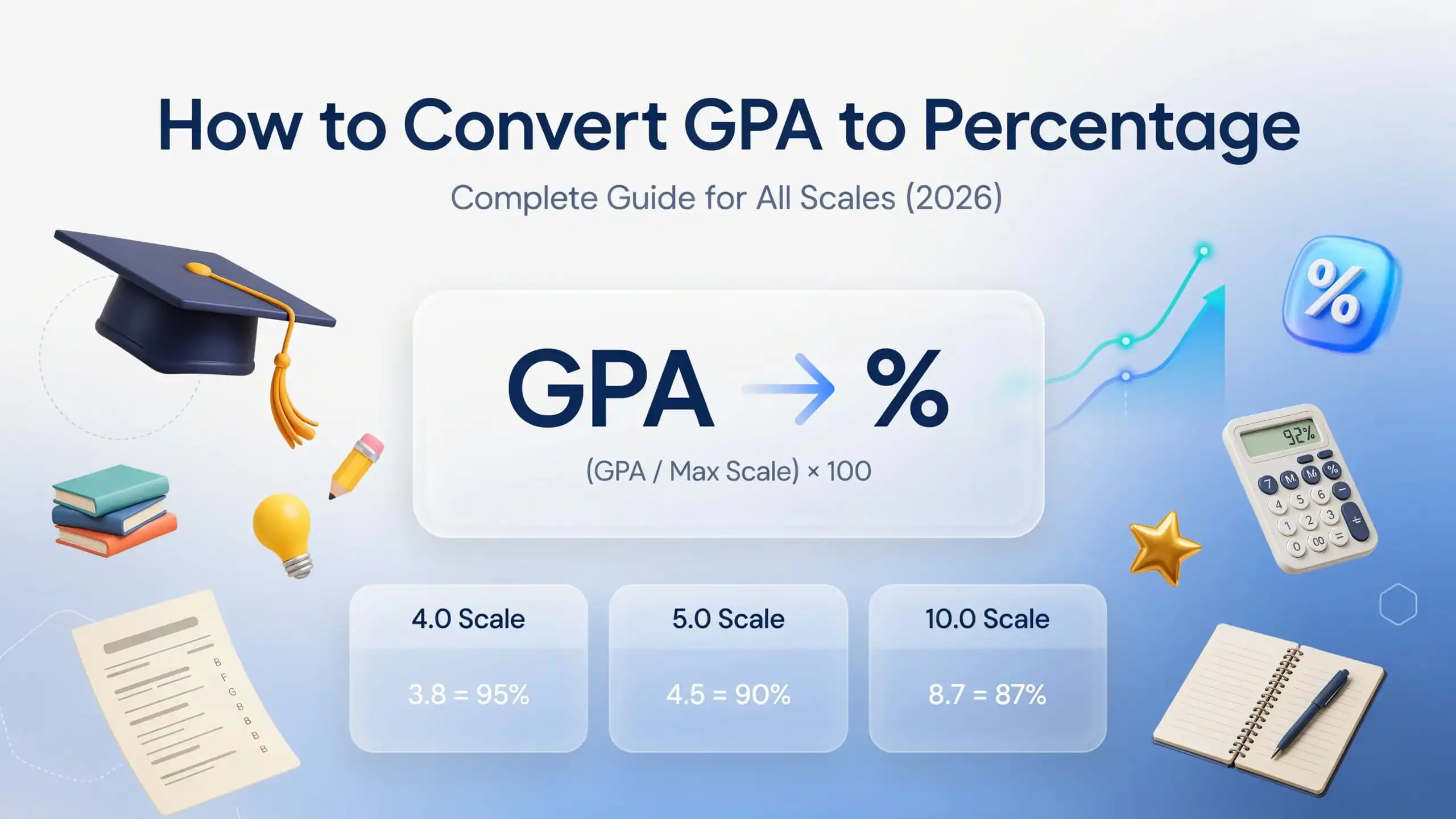
Percentage = (GPA ÷ 4.0) × 100
This is identical to multiplying your GPA by 25.
| GPA (4.0) | Percentage | Performance Level |
| 4.0 | 100% | Perfect / A+ |
| 3.9 | 97.5% | Exceptional |
| 3.7 | 92.5% | Excellent |
| 3.5 | 87.5% | Very Good |
| 3.3 | 82.5% | Good |
| 3.0 | 75% | Above Average |
| 2.7 | 67.5% | Average |
| 2.5 | 62.5% | Satisfactory |
| 2.0 | 50% | Pass |
| 1.7 | 42.5% | Below Average |
Important caveat: This formula is a widely accepted approximation — no universal standard exists, and results can differ by 5–10 percentage points depending on the conversion table the receiving institution uses. For quick estimates and informal applications, this formula works well. For official purposes — university admissions, visa documentation, professional licensing — use a credential evaluation service.
5.0 Scale
Percentage = (GPA ÷ 5.0) × 100
| GPA (5.0) | Percentage |
| 5.0 | 100% |
| 4.5 | 90% |
| 4.0 | 80% |
| 3.5 | 70% |
| 3.0 | 60% |
| 2.5 | 50% |
7.0 Scale (Australia)
Australian universities use a 7.0 GPA scale with specific grade labels: HD (High Distinction), D (Distinction), C (Credit), P (Pass), F (Fail).
Percentage = (GPA ÷ 7.0) × 100
| GPA (7.0) | Percentage | Australian Grade |
| 7.0 | 100% | HD |
| 6.0–6.9 | 85.7–98.6% | HD |
| 5.0–5.9 | 71.4–84.3% | D (Distinction) |
| 4.0–4.9 | 57.1–70% | C (Credit) |
| 3.0–3.9 | 42.9–55.7% | P (Pass) |
| Below 3.0 | Below 42.9% | F (Fail) |
10.0 Scale (India — CGPA)
Indian universities issue CGPA on a 10-point scale. This is technically CGPA, not GPA, but many Indian students and employers use the terms interchangeably. The conversion formula depends on your university:
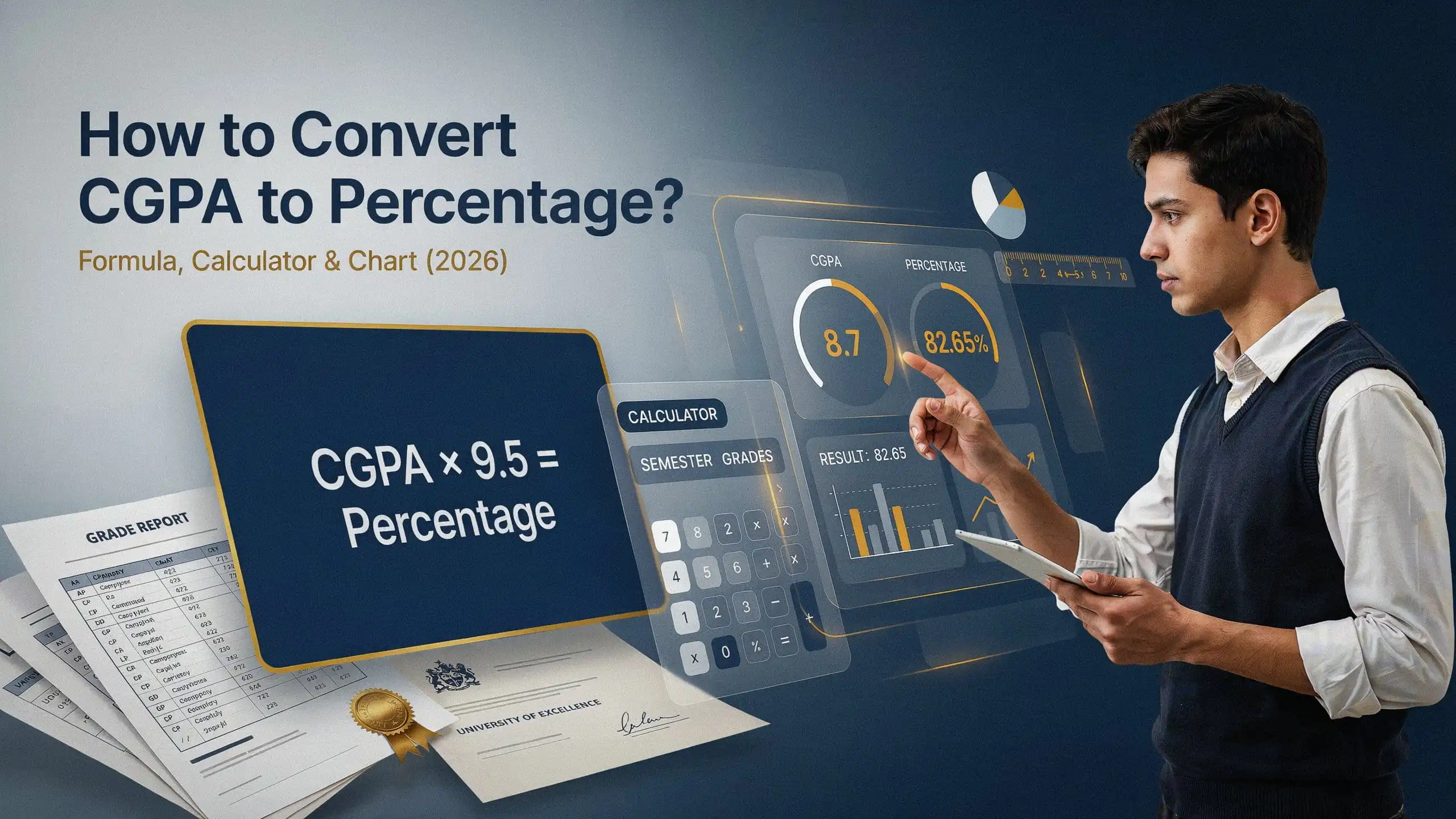
Percentage = CGPA × 9.5 (CBSE, MDU, and most UGC-affiliated universities) Percentage = CGPA × 10 (VTU, Anna University, JNTU, KTU, RGPV)
| CGPA (10.0) | × 9.5 | × 10 |
| 6.0 | 57% | 60% |
| 7.0 | 66.5% | 70% |
| 7.5 | 71.25% | 75% |
| 8.0 | 76% | 80% |
| 8.5 | 80.75% | 85% |
| 9.0 | 85.5% | 90% |
For the complete university-specific formula list, see: How to Convert CGPA to Percentage.
Percentage to GPA: Reverse Conversion
If you have a percentage and need to express it as GPA for a foreign application:
Percentage to 4.0 GPA
GPA = (Percentage ÷ 100) × 4.0
| Percentage | GPA (4.0) |
| 90%+ | 3.6 |
| 85% | 3.4 |
| 80% | 3.2 |
| 75% | 3.0 |
| 70% | 2.8 |
| 65% | 2.6 |
| 60% | 2.4 |
Percentage to Indian CGPA (10.0)
CGPA = Percentage ÷ 9.5 (for standard universities) CGPA = Percentage ÷ 10 (for VTU, Anna, JNTU, etc.)
Example: 76% → 76 ÷ 9.5 = 8.0 CGPA
Indian CGPA to US GPA: The Direction Most Students Actually Need
This is the most common conversion scenario for Indian students applying abroad — expressing their 10-point CGPA as a US 4.0 GPA.
Two-step process:
Step 1: Convert CGPA to percentage using your university's formula
Step 2: Convert percentage to 4.0 GPA using: GPA = (Percentage ÷ 100) × 4
Example — CBSE/standard university student:
- CGPA: 8.2
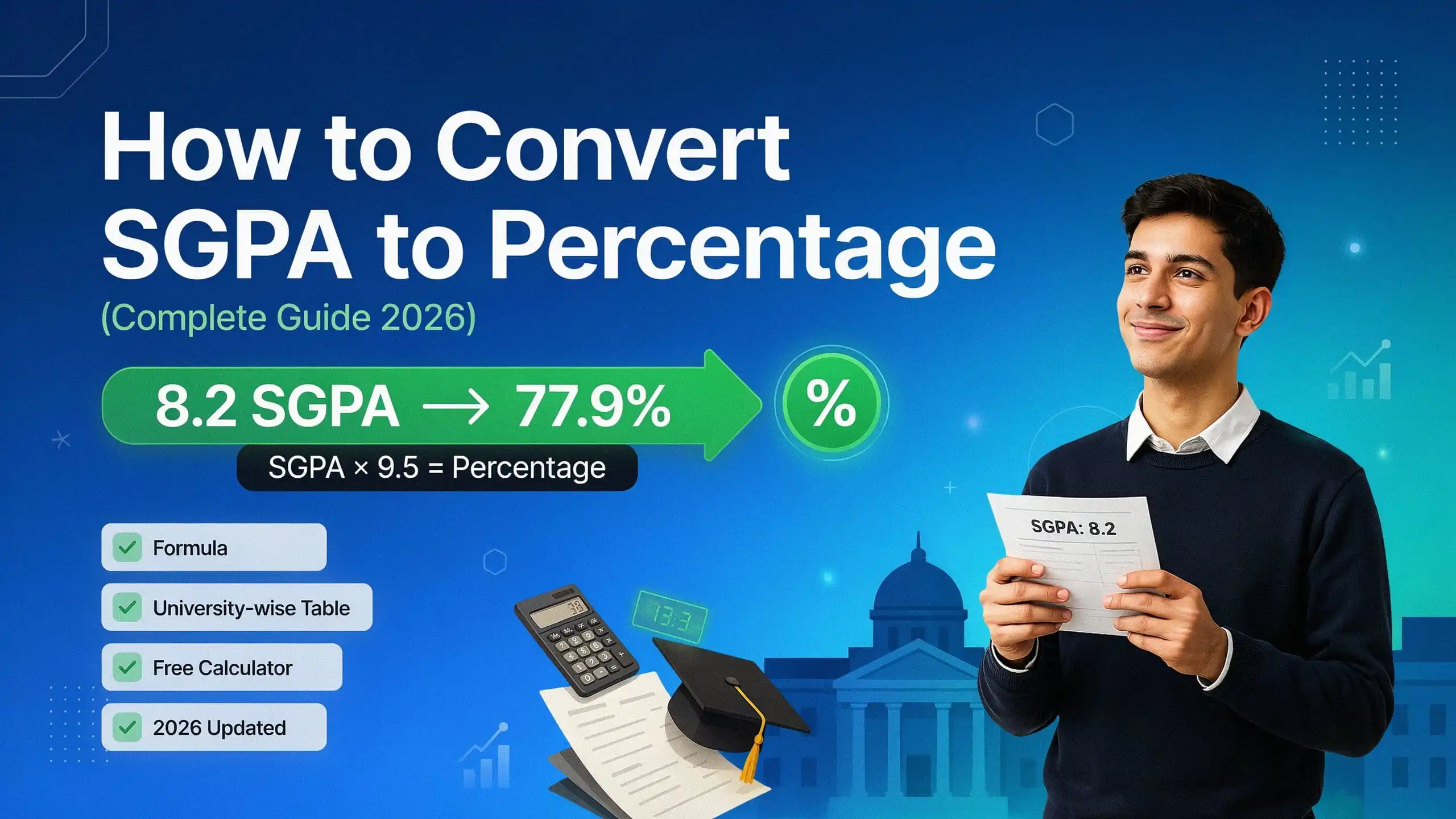
- Step 1: 8.2 × 9.5 = 77.9%
- Step 2: (77.9 ÷ 100) × 4 = 3.12 GPA
Example — VTU student:
- CGPA: 8.2
- Step 1: 8.2 × 10 = 82%
- Step 2: (82 ÷ 100) × 4 = 3.28 GPA
The same CGPA of 8.2 gives a different US GPA equivalent depending on your Indian university's formula. This difference — 3.12 vs 3.28 — can push a student above or below a program's minimum GPA cutoff.
Quick reference — Indian CGPA to US 4.0 GPA:
| Indian CGPA | % (×9.5) | US GPA (÷100×4) | % (×10) | US GPA (÷100×4) |
| 6.5 | 61.75% | 2.47 | 65% | 2.60 |
| 7.0 | 66.5% | 2.66 | 70% | 2.80 |
| 7.5 | 71.25% | 2.85 | 75% | 3.00 |
| 8.0 | 76% | 3.04 | 80% | 3.20 |
| 8.5 | 80.75% | 3.23 | 85% | 3.40 |
| 9.0 | 85.5% | 3.42 | 90% | 3.60 |
| 9.5 | 90.25% | 3.61 | 95% | 3.80 |
Country-Specific GPA Systems and Percentage Equivalents
United States (4.0 Scale)
The US 4.0 scale uses letter grades as the bridge between marks and GPA:
| Letter Grade | GPA Points | Typical % Range |
| A+ | 4.0 | 97–100% |
| A | 4.0 | 93–96% |
| A− | 3.7 | 90–92% |
| B+ | 3.3 | 87–89% |
| B | 3.0 | 83–86% |
| B− | 2.7 | 80–82% |
| C+ | 2.3 | 77–79% |
| C | 2.0 | 73–76% |
| D | 1.0 | 60–69% |
| F | 0.0 | Below 60% |
US universities do not use a direct mathematical formula to assign GPA from percentage. They assign letter grades first, then convert letter grades to GPA points. The percentage equivalents above reflect common institutional ranges — they vary between universities.
Germany (1.0–5.0 Reverse Scale)
Germany uses a reverse scale where lower is better. A German 1.0 is the highest grade (equivalent to an A in the US), and 5.0 is a fail.
Approximate conversion to percentage: Percentage ≈ (5 − German GPA) ÷ 4 × 100 (rough estimate only)
| German Grade | Meaning | Approximate % |
| 1.0–1.5 | Sehr gut (Very Good) | 85–100% |
| 1.6–2.5 | Gut (Good) | 70–84% |
| 2.6–3.5 | Befriedigend (Satisfactory) | 55–69% |
| 3.6–4.0 | Ausreichend (Sufficient/Pass) | 50–54% |
| 5.0 | Nicht bestanden (Fail) | Below 50% |
German universities — especially TU Munich and RWTH Aachen — use their own admission tables when evaluating international transcripts. Do not apply the rough formula above for official applications to German universities. Use their published Zulassungsordnung (admission regulation) or contact the university's international office.
United Kingdom
UK universities do not use GPA. They use degree classifications:
| UK Classification | Percentage Range | Approximate US GPA Equivalent |
| First Class (1st) | 70%+ | 3.7–4.0 |
| Upper Second (2:1) | 60–69% | 3.3–3.6 |
| Lower Second (2:2) | 50–59% | 2.7–3.2 |
| Third Class (3rd) | 40–49% | 2.0–2.6 |
When UK universities evaluate Indian students, they typically request the original transcript and convert internally. Most Russell Group universities expect a CGPA of 6.5–7.5 or above depending on the program.
Pakistan (HEC 4.0 Scale)
Pakistani universities following HEC guidelines use a 4.0 scale — the same as the US system.
Percentage = (GPA ÷ 4.0) × 100 (same as the US formula)
| HEC GPA | Percentage | Grade |
| 4.0 | 100% | A+ |
| 3.75 | 93.75% | A |
| 3.5 | 87.5% | A− |
| 3.2 | 80% | B+ |
| 3.0 | 75% | B |
| 2.5 | 62.5% | C |
| 2.0 | 50% | D |
Pakistani students converting for Indian university applications or job forms use this formula directly. For study abroad applications, the 4.0 GPA is already in the expected format for US and Canadian universities.
When to Use a Credential Evaluation Service (WES, ECE, SpanTran)
Self-calculated GPA conversions are fine for informal purposes — checking your own competitiveness, filling in an online interest form, or estimating your position. But some situations require a formally certified conversion:
Use services like WES (World Education Services), ECE, or SpanTran when: the application is official (university admission, visa, immigration, professional licensing); the receiving institution requires a certified conversion; your GPA is borderline for a scholarship or program; or you have a mix of weighted/unweighted courses or international transcripts.
These services cost between $100–250 USD but produce legally recognized reports that universities, immigration authorities, and professional licensing boards accept. They do not simply apply a formula — they evaluate your transcript in detail and produce an equivalency report based on your specific institution's grading practices.
For most Indian and Pakistani students applying to graduate programs in the US, WES or ECE evaluation is required by the university — not just recommended. Check the specific admissions requirements of each program before assuming a self-calculated GPA will be accepted.
GPA Minimums for Study Abroad — What You Actually Need in 2026
This is the practical output of the conversion — knowing whether your GPA or percentage clears the bar for programs you are targeting.
| Destination | Program | Typical Minimum | Indian CGPA Equivalent |
| USA — Top 50 MS | Engineering, CS | 3.0 GPA (75%) | 7.5–8.0 CGPA |
| USA — Top 10 MS | Engineering, CS | 3.5+ GPA (87.5%) | 8.5+ CGPA |
| USA — MBA (Top 20) | Business | 3.3+ GPA (82.5%) | 8.2+ CGPA |
| UK — Russell Group MSc | Most fields | 2:1 equiv. (60%+) | 6.5+ CGPA |
| Canada — Top universities | MS/MEng | 3.0 GPA (75%) | 7.5–8.0 CGPA |
| Germany — TU Munich, RWTH | MS Engineering | 70%+ equiv. | 7.5+ CGPA |
| Australia — Group of Eight | MS programs | 5.5/7 GPA (78%+) | 7.8+ CGPA |
| Singapore — NUS, NTU | MS programs | 3.5/5 GPA (70%) | 7.5+ CGPA |
These are general baselines. Actual cutoffs vary by department, program competitiveness, and application year. Always verify from the official admissions page of each program.
How to Present GPA on a Resume or Application
Always list both: write "GPA: 3.72 / 4.00 (≈ 93%)" — the native GPA satisfies ATS parsers; the percentage satisfies international HR teams. Include the scale denominator: writing "3.72 GPA" is ambiguous — "3.72 / 4.00 GPA" is crystal clear, as a reviewer who knows only a 10-point scale might misread 3.72 as dangerously low.
For Indian students presenting CGPA on international applications: Write: "CGPA: 8.2 / 10.0 (equivalent to 77.9% or 3.12 / 4.0 GPA)"
For Pakistani students on HEC 4.0 presenting to Indian employers: Write: "GPA: 3.2 / 4.0 (equivalent to 80%)"
For US students applying to Indian companies: Write: "GPA: 3.6 / 4.0 (equivalent to 90%)"
The rule is simple: always show the original scale and the denominator. Never leave a reviewer guessing what scale you are on.
Real Student Scenarios
Scenario 1: Priya Applies to US MS Programs
Priya has a CGPA of 8.4 from VTU. She is applying to three US universities, all of which ask for GPA on a 4.0 scale.
VTU formula: 8.4 × 10 = 84% US GPA: (84 ÷ 100) × 4 = 3.36 GPA
The first university requires minimum 3.0 — she clears it. The second requires 3.5 — she does not meet the formal minimum but is close enough that a strong GRE score and SOP may compensate. Had she used the generic 9.5 formula (giving 79.8% → 3.19 GPA), she would have underestimated her competitiveness for both programs.
Scenario 2: Hamza Applies for a Job in Dubai
Hamza graduated from COMSATS Islamabad with a 3.3 GPA on the HEC 4.0 scale. A Dubai employer's online application form asks for academic percentage.
(3.3 ÷ 4.0) × 100 = 82.5%
He enters 82.5% on the form. The employer's threshold is 70% — he clears it comfortably. Had he entered 3.3 directly in the percentage field, the system would have read 3.3% and rejected him automatically.
Scenario 3: Arjun Evaluates His WES Requirement
Arjun has a CGPA of 7.9 from AKTU and is applying to a Canadian university that requires a WES evaluation. He checks the university's requirements and confirms that WES is mandatory, not optional.
He cannot just calculate (7.9 − 0.5) × 10 = 74% → 2.96 GPA and submit that figure. The university requires a certified WES report. He applies to WES, submits his official transcripts, and receives an equivalency report showing his Canadian GPA equivalent — which WES calculates based on AKTU's specific grading practices, not a generic formula.
This is the correct approach for official university applications. Self-calculated conversions are for estimation only.
Scenario 4: Sara Converts Her UK Degree for an Indian Job
Sara completed her MSc from the University of Manchester with an Upper Second Class (2:1) degree and an overall percentage of 64%. She is applying to an Indian company that asks for percentage in their form.
She enters 64% directly — because her UK degree was graded as percentage, not GPA. There is no conversion needed. If the form had asked for GPA, she would note that her UK degree does not use a GPA scale and provide the degree classification with percentage instead.
Common Mistakes When Converting GPA to Percentage
Applying the wrong scale formula A Pakistani student on the HEC 4.0 scale and an Indian student on a 10-point CGPA scale both need completely different formulas. Using the 4.0 formula on a 10-point CGPA produces a nonsensical result (8.0 × 25 = 200%).
Using Indian CGPA × 9.5 for US GPA The × 9.5 formula converts CGPA to Indian percentage — not to US GPA. You need an extra step: convert to percentage first, then convert percentage to GPA.
Treating the formula as officially accepted Self-calculated GPA conversions are estimates. For university admissions, visa applications, and professional licensing, use WES or ECE. Submitting a self-calculated figure on a form that requires certified evaluation can invalidate your application.
Omitting the scale denominator Writing "3.2 GPA" without specifying "out of 4.0" creates confusion. Always write the full notation: 3.2 / 4.0.
Entering raw GPA in a percentage field 3.2 GPA in a percentage field reads as 3.2% — nearly zero. Always convert before entering.
Free Grade Converter at AIHomeworkHelps
For quick GPA to percentage estimates across 4.0, 5.0, and 10.0 scales, use the free Grade Converter at AIHomeworkHelps. It gives you instant results for all common scales without manual arithmetic — useful for checking your competitiveness before finalizing a university shortlist or filling in application forms.
For understanding how CGPA and SGPA differ before converting either one, see: Difference Between CGPA and SGPA.
Final Thought
Converting GPA to percentage — or percentage to GPA — is not a single formula. The scale you are working with determines the formula, the formula gives you an estimate, and the estimate is enough for most informal and self-assessment purposes. For official university admissions, visa applications, and professional licensing, a certified credential evaluation from WES or ECE is the appropriate step.
Know your scale. Apply the right formula. Present your score with the denominator clearly shown. And verify using the free Grade Converter at AIHomeworkHelps before filling in any high-stakes form.
Faq's
How do you convert GPA to percentage?
Divide your GPA by the maximum GPA on your scale and multiply by 100. For 4.0 scale: (GPA ÷ 4) × 100. For 10.0 scale (Indian CGPA): use CGPA × 9.5 or × 10 depending on your university.
Do US universities accept Indian percentage directly?
Most US universities are familiar with the Indian grading system and accept your percentage or CGPA directly from your official transcripts. Some universities or credential evaluation requirements (such as WES or ECE) may convert your scores to the US GPA scale. Always check the specific requirements on the admissions page of each university.
What is a good GPA for study abroad?
For US MS programs: 3.0+ (75%+) is the general minimum; top programs prefer 3.5+ (87.5%+). For UK Russell Group: 2:1 equivalent (60%+). For Germany: 70%+ equivalent. Check each program's official page for current requirements.
Is GPA the same as CGPA?
In India, GPA and CGPA are often used interchangeably but technically CGPA means cumulative — across all semesters. GPA in the US context usually means the same cumulative figure on a 4.0 scale. The key difference is the scale: India uses 10.0, the US uses 4.0. See: Difference Between CGPA and SGPA for a full breakdown.
Should I include GPA on my resume if it is below 3.0?
The widely accepted guideline is to include GPA only if it strengthens your application — generally 3.5 / 4.0 or above. If your GPA is below 3.0, omit it from your resume unless the employer or university explicitly requires it.